Everything you need to know before traveling to the Philippines — passports, visas, eTravel registration, customs rules, and health requirements.
Quick Summary
| Requirement | Details |
|---|---|
| Passport validity | At least 6 months beyond your stay |
| Visa-free stay | 30 days for 157+ nationalities |
| eTravel registration | Mandatory, free of charge |
| Return/onward ticket | Required for visa-free entry |
| COVID-19 requirements | No longer required (removed 2023) |
Valid Passport
Your passport must be valid for at least six (6) months beyond your intended period of stay in the Philippines. This is a strict requirement enforced by the Bureau of Immigration (BI) and airlines alike. Passports with less than six months’ validity will be denied boarding or entry.
Make sure your passport has at least one blank page for the entry stamp. Damaged or tampered passports may also result in denial of entry.
Visa-Free Entry
The Philippines grants visa-free entry to nationals of over 157 countries and territories. The permitted stay depends on your nationality:
30-Day Visa-Free Entry
Most nationalities — including citizens of the United States, Canada, Australia, Japan, South Korea, and most European Union countries — can enter the Philippines without a visa for up to 30 days for tourism or business purposes.
59-Day Visa-Free Entry
Citizens of Brazil and Israel enjoy an extended 59-day visa-free stay.
14-Day Visa-Free Entry
Nationals of India, China, and Taiwan may enter visa-free for up to 14 days under recent policy changes (2025–2026).
- India: 14 days visa-free for all Indian tourists; 30 days for those holding valid visas from the US, UK, Schengen area, Australia, Canada, Japan, or Singapore.
- China: 14 days visa-free (temporary policy through January 15, 2027).
- Taiwan: 14 days visa-free (effective through June 30, 2027).
ASEAN Nationals
Citizens of ASEAN member states (Brunei, Cambodia, Indonesia, Laos, Malaysia, Myanmar, Singapore, Thailand, Vietnam) enjoy visa-free entry for 30 days under regional agreements.
Visa Requirements for Restricted Nationals
If your country is not on the visa-free list, you must obtain a visa before traveling. Options include:
- 9(a) Tourist Visa: Apply at the nearest Philippine embassy or consulate.
- eVisa: Available to eligible nationalities through the official Philippine eVisa portal. Single-entry, multiple-entry (6 months or 1 year) options are available.
- Visa on Arrival (SEVUA): Limited to certain categories of travelers.
eTravel Registration (Mandatory)
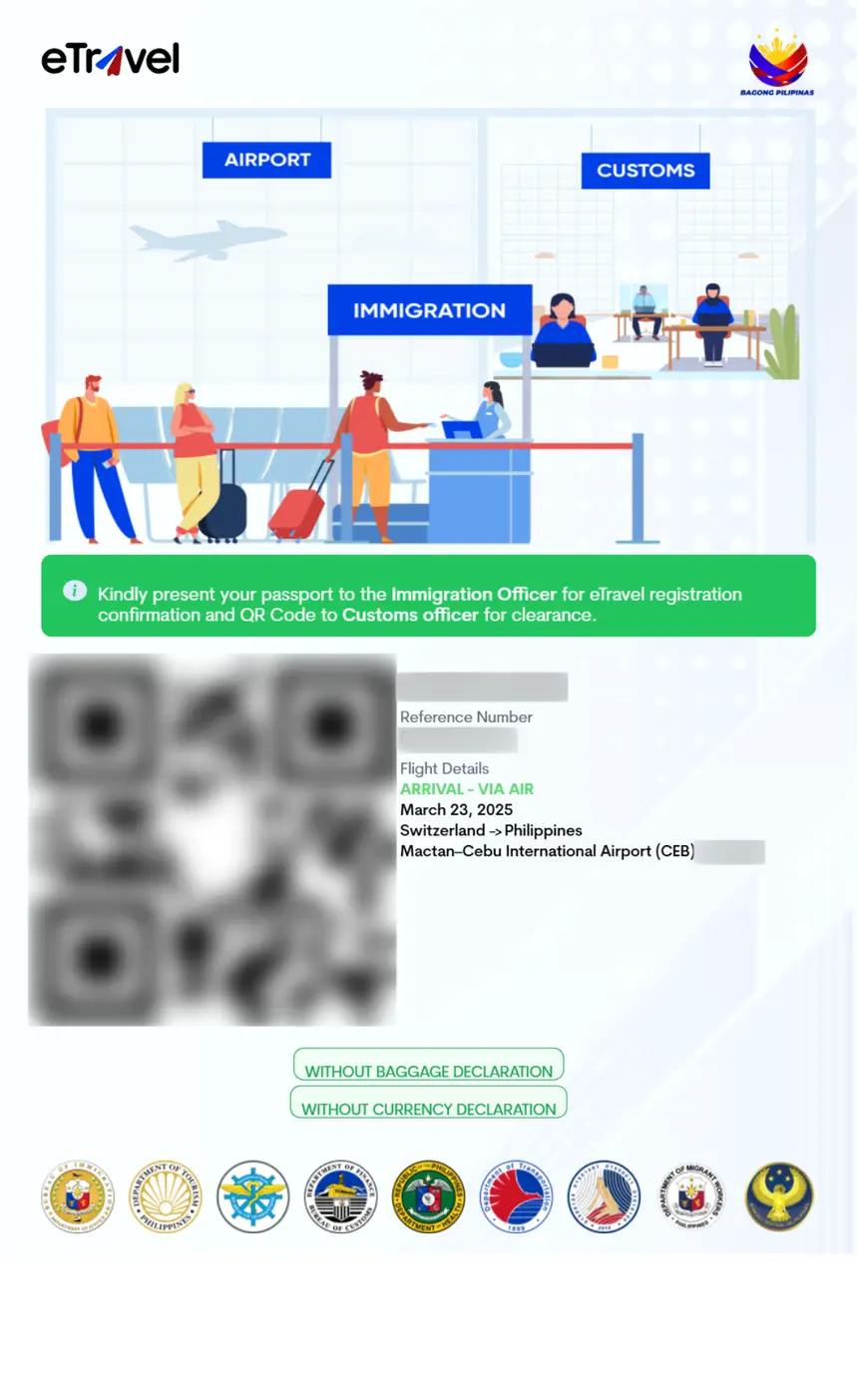
All travelers — Filipino citizens and foreign nationals alike — must complete eTravel registration before arriving in the Philippines. This is the country’s digital arrival card system, replacing the old paper-based embarkation/disembarkation forms.
How to Register
- Visit etravel.gov.ph or download the eGovPH app (iOS/Android).
- Fill out the registration form with your personal details, flight information, and accommodation in the Philippines.
- Submit at least 72 hours before your flight.
- Save or screenshot the generated QR code.
- Present the QR code to immigration officers upon arrival.
eTravel registration is completely free. Beware of unofficial websites that charge fees.
Return or Onward Ticket
All visa-free visitors must hold a return or onward ticket departing the Philippines within the allowed visa-free period. Airlines may deny boarding if you cannot show proof of onward travel at check-in.
If you plan to extend your stay beyond the initial visa-free period, you can apply for an extension at any Bureau of Immigration office. Visa-exempt nationals may extend up to 2 months per extension, with a maximum total stay of 2 years.
Customs and Duty-Free Allowances
Upon arrival, you may bring the following into the Philippines duty-free:
- Up to 200 cigarettes or 50 cigars or 250g of tobacco
- Up to 2 bottles of alcohol (not exceeding 1 liter each)
- Personal effects and goods valued up to PHP 10,000
You must declare amounts exceeding these limits. Bringing in prohibited items (drugs, firearms, obscene materials) is a criminal offense under Philippine law.
Currency Declaration
You may bring in any amount of foreign currency, but amounts exceeding USD 10,000 (or equivalent) must be declared to customs upon arrival.
Health Requirements
COVID-19
As of 2023, the Philippines has removed all COVID-19-related entry requirements. Vaccination certificates, negative tests, and travel insurance covering COVID-19 are no longer mandatory.
Recommended Vaccinations
While not strictly required for entry, the following vaccinations are recommended by health authorities:
- Hepatitis A and B
- Typhoid
- Tetanus-diphtheria
- Rabies (for extended stays or rural travel)
Yellow Fever
Travelers arriving from countries with risk of yellow fever transmission must present a valid yellow fever vaccination certificate. This applies regardless of your nationality if you have visited or transited through a yellow fever endemic country.
Balikbayan Privilege
Former Filipino citizens (and their immediate family members) who have naturalized in another country can enter the Philippines visa-free for up to one year under the Balikbayan Program. To qualify:
- Present a foreign passport plus proof of former Philippine citizenship (e.g., old Philippine passport, birth certificate, or Certificate of Reacquisition under RA 9225).
- Travel with a Filipino spouse or child, or be a former Filipino yourself.
Special Visa Categories
For stays longer than what visa-free entry allows, or for purposes other than tourism, the Philippines offers several visa types:
| Visa | Purpose | Duration |
|---|---|---|
| 9(a) Tourist Visa | Tourism, business, health | 59 days, extendable |
| 9(f) Student Visa | Academic study | Duration of study |
| 9(g) Work Visa | Pre-arranged employment | Per contract |
| 13(a) Immigrant Visa | Spouse/child of Filipino citizen | Permanent |
| SRRV | Retirees | Permanent renewable |
| SIRV | Investors | Permanent renewable |
Departure Requirements
Before leaving the Philippines, ensure you have:
- A valid passport
- A confirmed onward ticket
- Paid the travel tax (PHP 1,620 for economy class; PHP 2,700 for first/business class) — usually included in your airline ticket price
- An Emigration Clearance Certificate (ECC) if you have stayed more than 6 months
Frequently Asked Questions
Do I need a visa if I’m just transiting through the Philippines?
Transit passengers who remain in the airport’s international transit area and hold confirmed onward tickets within 24 hours generally do not need a visa. If you wish to leave the airport, you will need to meet standard entry requirements.
Can I extend my stay in the Philippines?
Yes. Visa-exempt visitors can extend their stay at any Bureau of Immigration office. The first extension is typically 29 days, with further 2-month extensions available up to a total stay of 2 years.
What happens if I overstay?
Overstaying your permitted period results in fines and penalties. You will be required to pay an overstay fine plus an extension fee before you can leave the country. Serious overstays may result in deportation and being blacklisted from re-entering the Philippines.
Is travel insurance required?
Travel insurance is not mandatory for entry, but it is strongly recommended. Medical care in the Philippines can be expensive, and emergency evacuation may be necessary for serious injuries or illnesses.
Do children need separate eTravel registration?
Yes. All travelers, including infants and children, must have their own eTravel registration. Parents or guardians can register minors through the same account.
Key Contacts
- Bureau of Immigration: immigration.gov.ph
- eTravel Registration: etravel.gov.ph
- Department of Foreign Affairs: dfa.gov.ph
- Philippine eVisa: evisa.gov.ph
Last updated: July 2026. Entry requirements may change without notice. Always verify current requirements with your airline and the nearest Philippine embassy or consulate before traveling.