
What Is a Philippines Tourist Visa?
A Philippines tourist visa is an official travel document that permits foreign nationals to enter the country for leisure, sightseeing, visiting friends or family, or short-term recreational activities. The Philippines attracts millions of visitors each year with its 7,641 islands, world-class beaches, and rich cultural heritage. Understanding the visa process is the first step toward planning your trip.
The Philippine government offers several pathways for tourists. Citizens of over 150 countries can enter visa-free for stays of up to 30 days, while others must apply for a tourist visa at a Philippine embassy or consulate before traveling.
Who Needs a Tourist Visa for the Philippines?
Visa-Free Entry (Up to 30 Days)
Nationals of the following countries do not need a tourist visa for stays of 30 days or less:
- North America: United States, Canada
- Europe: United Kingdom, Germany, France, Spain, Italy, Netherlands, Belgium, Sweden, Norway, Denmark, Finland, Austria, Switzerland, Poland, Czech Republic, Portugal, Greece, Hungary, Ireland, Luxembourg
- Asia-Pacific: Japan, South Korea, Australia, New Zealand, Singapore, Malaysia, Thailand, Indonesia, Brunei, Hong Kong, Macau, Taiwan
- South America: Brazil, Argentina, Chile, Colombia, Peru, Ecuador
A valid passport with at least six months of remaining validity beyond your intended stay is required for visa-free entry.
Countries That Require a Tourist Visa
If your nationality is not on the visa-exempt list, you must obtain a tourist visa before arriving. Countries that typically require a pre-arranged visa include:
- India
- China
- Pakistan
- Bangladesh
- Sri Lanka
- Nepal
- Nigeria
- Ghana
- Egypt
Check the official Philippine Bureau of Immigration or Department of Foreign Affairs website for the complete, up-to-date list of visa-required nationalities.
Types of Philippines Tourist Visas
9(a) Tourist Visa
The most common type for leisure travelers. Key details:
- Duration: 30 days to 59 days (single or multiple entry)
- Validity: Typically 3 months from the date of issue
- Extensions: Can be extended at any Bureau of Immigration office in the Philippines
- Fee: Approximately PHP 2,500-4,500 (USD 45-80) depending on the embassy
Transit Visa
For travelers passing through the Philippines en route to another destination:
- Duration: Up to 72 hours
- Requirements: Confirmed onward ticket
- Fee: Varies by embassy
How to Apply for a Philippines Tourist Visa
Step 1: Gather Required Documents
Prepare the following documents before your application:
| Document | Details |
|---|---|
| Valid passport | Minimum 6 months validity beyond travel dates |
| Completed visa application form | Available from the Philippine embassy website |
| Passport-sized photos | Two recent photos (3.5 x 4.5 cm), white background |
| Proof of accommodation | Hotel reservation or invitation letter from a Philippine resident |
| Round-trip flight booking | Confirmed itinerary showing entry and exit dates |
| Proof of financial means | Bank statements from the last 3 months |
| Employment certificate | Letter from employer confirming your position and salary |
| Travel insurance | Covering medical emergencies for the duration of your stay |
Step 2: Submit Your Application
Applications can be submitted through:
- In person at the nearest Philippine embassy or consulate
- By mail to some embassies (check local requirements)
- Online through the Philippine e-Visa portal (available for select nationalities as of 2026)
Step 3: Pay the Visa Fee
Tourist visa fees vary by country and visa type:
| Visa Type | Approximate Fee |
|---|---|
| Single-entry (up to 3 months) | USD 30-40 |
| Multiple-entry (up to 6 months) | USD 60-90 |
| Multiple-entry (up to 1 year) | USD 90-120 |
Step 4: Wait for Processing
Standard processing takes 5-10 business days. Expedited processing may be available for an additional fee at some embassies, reducing the wait to 2-3 business days.
Philippines Tourist Visa Extensions
If you wish to stay beyond the initial visa-free or visa period, you can extend your stay at any Bureau of Immigration (BI) office in the Philippines.
Extension Fees and Durations
| Extension | Duration Added | Approximate Fee |
|---|---|---|
| 1st extension | 29 days | PHP 3,030 |
| 2nd extension | 29 days | PHP 3,030 |
| 3rd extension | 29 days | PHP 3,030 |
| ACR I-Card (required after 59 days) | N/A | PHP 3,000 |
| 2-month extension after ACR | 2 months | PHP 2,130 |
| 6-month extension | 6 months | PHP 4,130 |
Travelers can stay in the Philippines for up to 36 months on tourist visa extensions, subject to approval.
Balikbayan Privilege
Former Filipino citizens and their immediate family members (spouse and children) can enter the Philippines visa-free for up to 1 year under the Balikbayan Program. Eligible travelers must carry:
- Proof of former Philippine citizenship (e.g., old Philippine passport, birth certificate)
- Valid foreign passport
- Marriage certificate or birth certificate for accompanying family members
The Philippine e-Visa System
In 2025-2026, the Philippines began rolling out its electronic visa (e-Visa) system. Key points:
- Available for: Select nationalities (expanding in phases)
- Application process: Fully online – upload documents, pay fees, receive e-visa via email
- Processing time: 3-5 business days
- Cost: Same as traditional visa fees
The e-Visa system aims to simplify the application process and reduce the need for in-person visits to embassies.
Entry Requirements Beyond the Visa
All tourists, regardless of nationality, must also meet these requirements:
eTravel Registration
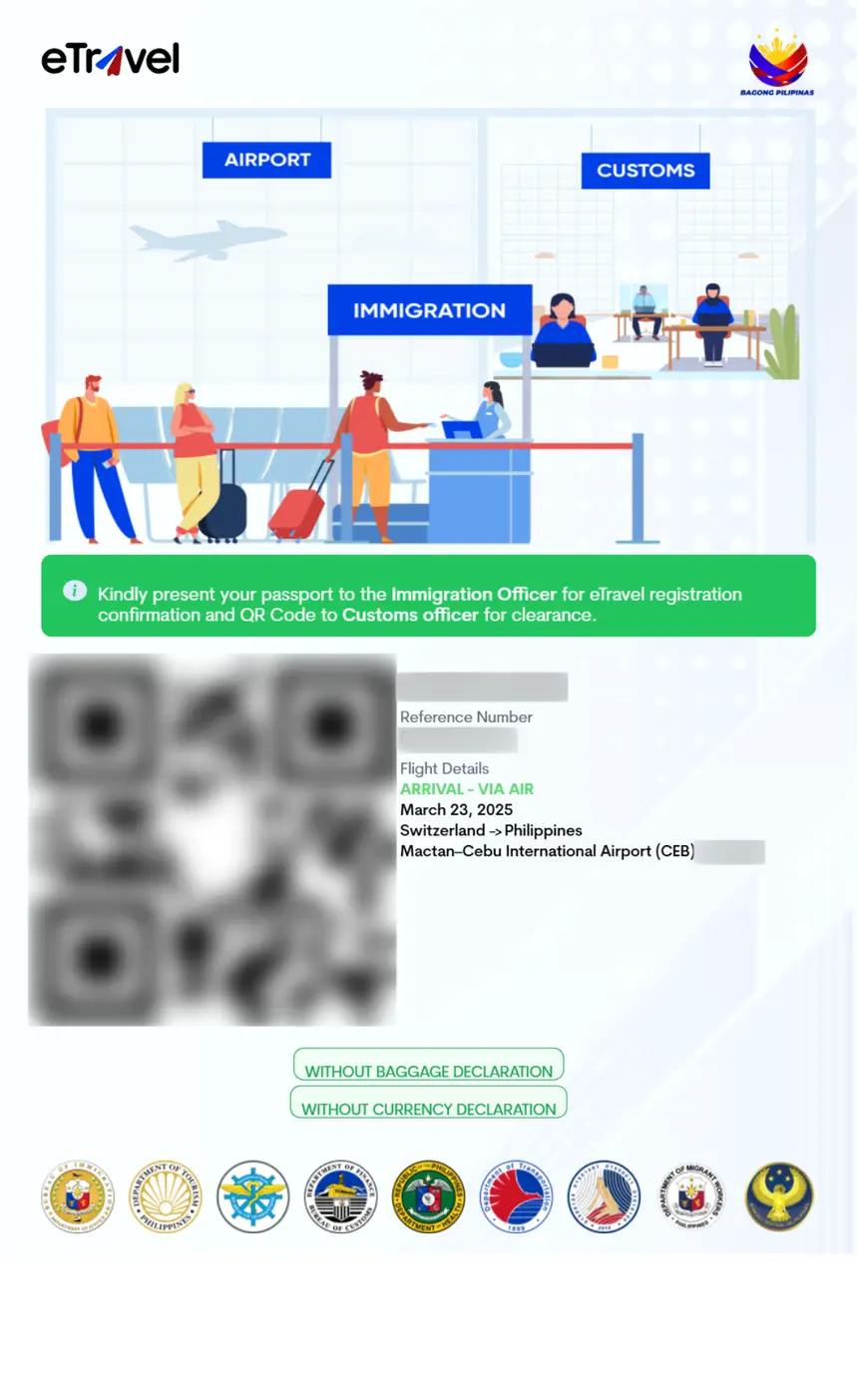
Before departing for the Philippines, all arriving travelers must complete the eTravel registration online at etravel.gov.ph. This digital health and immigration declaration must be completed within 72 hours before your flight. You will receive a QR code to present upon arrival.
Immigration Requirements at the Port of Entry
Upon arrival, Philippine immigration officers may ask for:
- Return or onward ticket
- Proof of accommodation
- Evidence of sufficient funds
- Travel itinerary
Overstaying your authorized period of stay is a serious offense in the Philippines. Penalties include fines of PHP 1,000 per month of overstay, detention, deportation, and being blacklisted from future entry.
Frequently Asked Questions
How long can I stay in the Philippines without a visa?
Citizens of visa-exempt countries can stay for up to 30 days without a visa. This can be extended at a Bureau of Immigration office for up to 36 months total.
Can I convert a tourist visa to a work visa while in the Philippines?
Tourist visas cannot be directly converted. You must exit the Philippines, apply for the appropriate work or long-stay visa at a Philippine embassy abroad, and re-enter.
How much money do I need to show for a tourist visa application?
There is no official minimum, but embassies generally expect applicants to show at least USD 1,000-2,000 in available funds for a short trip, or approximately USD 200-300 per week of stay.
Can I work in the Philippines on a tourist visa?
No. Working in the Philippines on a tourist visa is illegal. You must obtain an appropriate work visa and Alien Employment Permit (AEP) from the Department of Labor and Employment (DOLE).
What happens if I overstay my visa?
Overstaying results in fines of approximately PHP 1,000 per month, plus additional penalties. Extended overstays can lead to detention, deportation, and a ban on re-entering the Philippines. The Bureau of Immigration actively enforces these rules.
Is travel insurance required for a Philippines tourist visa?
While not always mandatory for visa-free travelers, travel insurance is strongly recommended. For visa-required nationalities, some embassies require proof of travel medical insurance covering the stay period.
Do children need a separate tourist visa?
Yes. Every traveler, including infants and children, needs their own valid passport and visa (or meets visa-free entry requirements). Children traveling without both parents may need additional documents such as a DSWD travel clearance or a notarized consent letter from the absent parent.