
The Philippines maintains one of the most open visa policies in Southeast Asia, welcoming visitors from 157 countries without requiring a pre-arranged visa. Whether you are planning a short beach holiday, a business trip, or a long-term stay, understanding the country’s visa framework is essential for a smooth entry. This comprehensive guide covers every aspect of Philippine visa policy as of 2026, including visa-free entry rules, visa categories, application procedures, extensions, and the mandatory eTravel registration system.
Who Sets Philippine Visa Policy?
Philippine immigration law is primarily governed by Commonwealth Act No. 613, also known as the Philippine Immigration Act. Two government bodies share responsibility for enforcement:
- Department of Foreign Affairs (DFA): Responsible for visa issuance through Philippine embassies and consulates abroad, and for maintaining the list of visa-free eligible countries.
- Bureau of Immigration (BI): Responsible for administering immigration laws at ports of entry, processing extensions, and overseeing the stay of foreign nationals within the country.
The Philippine eVisa portal (evisa.gov.ph), launched by the DFA, now allows eligible nationals to apply for certain visa types entirely online.
Visa-Free Entry: 157 Countries Eligible
The Philippines grants visa-free entry to nationals of 157 countries and territories. The permitted duration of stay depends on the visitor’s nationality and any bilateral agreements between the Philippines and their home country.
Stay Duration Tiers
| Duration | Eligible Nationalities |
|---|---|
| 59 days | Brazil, Israel, and select others with bilateral agreements |
| 30 days | Most eligible nationalities, including the United States, Canada, United Kingdom, Australia, New Zealand, Japan, South Korea, and all EU/Schengen member states |
| 14 days | India (standard visa-free), China (effective January 16, 2026, temporary policy until January 15, 2027) |
| 7 days | British Nationals (Overseas) passport holders from Hong Kong |
All ASEAN member state citizens also enjoy visa-free entry to the Philippines under regional agreements.
Key Conditions for Visa-Free Entry
To enter the Philippines without a visa, you must meet the following requirements:
- Passport validity: Your passport must be valid for at least six months beyond your intended period of stay.
- Return or onward ticket: You must hold a confirmed ticket for departure from the Philippines within your permitted visa-free period.
- eTravel registration: All arriving foreign nationals must complete the mandatory eTravel registration (see below).
- No derogatory record: You must not be on the Bureau of Immigration’s blacklist or have any outstanding immigration violations.
Recent Changes to Visa-Free Policy (2025-2026)
The Philippines has expanded its visa-free program significantly in recent months:
- India (June 8, 2025): Indian nationals now receive 14 days of visa-free entry. Those holding valid visas or permanent residency from Australia, Canada, Japan, Schengen countries, Singapore, the United Kingdom, or the United States qualify for an enhanced 30-day conditional visa-free stay.
- China (January 16, 2026): Chinese nationals holding PRC, Hong Kong SAR, or Macao SAR passports may enter visa-free for tourism or business for up to 14 days. This is a temporary policy valid until January 15, 2027, and entry is currently limited to Ninoy Aquino International Airport (Manila) and Mactan-Cebu International Airport (Cebu).
- Taiwan (July 1, 2025): Taiwanese nationals may obtain an Electronic Travel Authorization (ETA) through the Manila Economic and Cultural Office for stays of up to 30 days. This policy is valid until June 30, 2027.
Philippine Visa Types
For travelers who are not eligible for visa-free entry or who need to stay longer than their visa-free allowance, the Philippine Immigration Act prescribes several visa categories grouped into two broad classifications: non-immigrant visas and immigrant visas.
Non-Immigrant Visas (Section 9)
Non-immigrant visas are intended for temporary stays. The main categories include:
9(a) Temporary Visitor’s Visa – The most common visa type, covering tourism, business, medical treatment, and other short-term purposes. Sub-categories include:
- 9(a-1): Business visitors attending meetings, conferences, or conducting commercial activities without receiving Philippine-sourced compensation.
- 9(a-2): Tourism and leisure visitors, including those visiting family or friends.
- 9(a-3): Medical treatment visitors and their escorts.
- 9(a-4): Private yachtsmen and sailors arriving by personal vessel.
- 9(a-5): Filmmaking visitors producing movies or documentaries.
- 9(a-6): Journalism visitors covering news stories.
- 9(a-7): Athletic and performing arts visitors.
- 9(a-8): Visitors with other specialized purposes.
9(b) Transit Visa – For travelers passing through the Philippines en route to another destination.
9(c) Seaman’s Visa – For crew members of vessels docking at Philippine ports.
9(d) Treaty Trader/Investor Visa – For foreign nationals conducting substantial trade between their home country and the Philippines under a bilateral treaty.
9(e) Foreign Government Official Visa – For accredited foreign government officials, their dependents, and staff.
9(f) Student Visa – For foreign nationals enrolled in accredited Philippine educational institutions.
9(g) Pre-Arranged Employment Visa – For foreign nationals who have secured employment with a Philippine-based employer before arriving in the country. This is the standard work visa category.
Immigrant Visas (Section 13)
Immigrant visas are for foreign nationals seeking permanent residence in the Philippines:
- Section 13 (Quota Immigrant): Limited to 50 nationals per country per calendar year. Applicants must demonstrate financial capacity and good character.
- 13(a) Spouse/Child of Filipino Citizen: For the spouse or unmarried child (under 21) of a Philippine citizen.
- 13(b) Born Abroad to Permanent Resident Mother: For children born during a temporary visit abroad to mothers granted Philippine permanent residence.
- 13(c) Born After Visa Issuance: For children born after the issuance of the accompanying parents’ immigrant visa.
- 13(d) Former Filipino Women: For women who lost Filipino citizenship through marriage to a foreign spouse, and their unmarried children under 21.
- 13(e) Returning Permanent Resident: For permanent residents returning to the Philippines from a temporary visit abroad.
- 13(f) Spouse/Child of Pre-Act Immigrant: For the spouse and unmarried children under 21 of an alien admitted for permanent residence prior to the Philippine Immigration Act.
- 13(g) Natural-Born Filipino: For natural-born Filipinos who have naturalized in a foreign country and wish to permanently reside in the Philippines, as provided under Republic Act No. 4376.
Special Visas
The Philippines also offers several special visa categories created by subsequent legislation:
- SIRV (Special Investor’s Resident Visa): For foreign nationals with shareholdings in Philippine manufacturing, services, or listed companies. Issued by the Bureau of Immigration in coordination with the Board of Investments.
- SVEG (Special Visa for Employment Generation): For foreign nationals who employ at least ten Filipinos in a lawful enterprise.
- SRRV (Special Resident Retiree’s Visa): For foreign nationals who wish to retire in the Philippines. Issued in coordination with the Philippine Retirement Authority.
- 47(a)(2) Special Non-Immigrant Visa: For employees of PEZA-registered enterprises, BOI-approved projects, exchange scholars, volunteers, and their dependents.
- SNIV: For employees of multinational corporation regional headquarters.
- SEVOBU: For employees of Philippine offshore banking units.
The eVisa System
The Philippine government has launched an official eVisa portal at evisa.gov.ph, allowing eligible nationals to apply for visas online. Key details:
- Eligible nationalities: Citizens of select countries can apply for single-entry (valid 3 months) or multiple-entry (valid 6 months or 1 year) eVisas.
- Stay duration: eVisa holders may stay in the Philippines for up to 59 days per visit.
- Processing: Applications are submitted entirely online with digital document uploads.
- Important limitations: Philippine eVisas are not valid for conversion to other visa types and cannot be extended. The eVisa does not guarantee automatic admission – immigration officers at the port of entry make the final decision.
Visa Extensions
If you wish to stay in the Philippines beyond your initial authorized period, you can apply for an extension through the Bureau of Immigration.
Extension Rules by Visa Type
- Visa-free nationals: May extend their stay by two months per extension, up to a maximum total stay of two years.
- Visa-required nationals: May extend their stay by one month per extension, up to a maximum total stay of six months. They must also hold a valid onward travel ticket.
- eVisa holders: Cannot extend their authorized stay. They must leave the Philippines and reapply if they wish to return.
How to Apply for an Extension
Extensions can be obtained at Bureau of Immigration offices located throughout the Philippines, or online through the BI e-Services portal. The process typically involves:
- Completing the extension application form.
- Submitting your passport and current visa documentation.
- Paying the applicable extension fee.
- Receiving your updated visa stamp or documentation.
It is strongly recommended to apply for your extension before your current authorized stay expires. Overstaying without authorization is a serious matter and can result in fines, detention, or deportation at your own expense.
Mandatory eTravel Registration
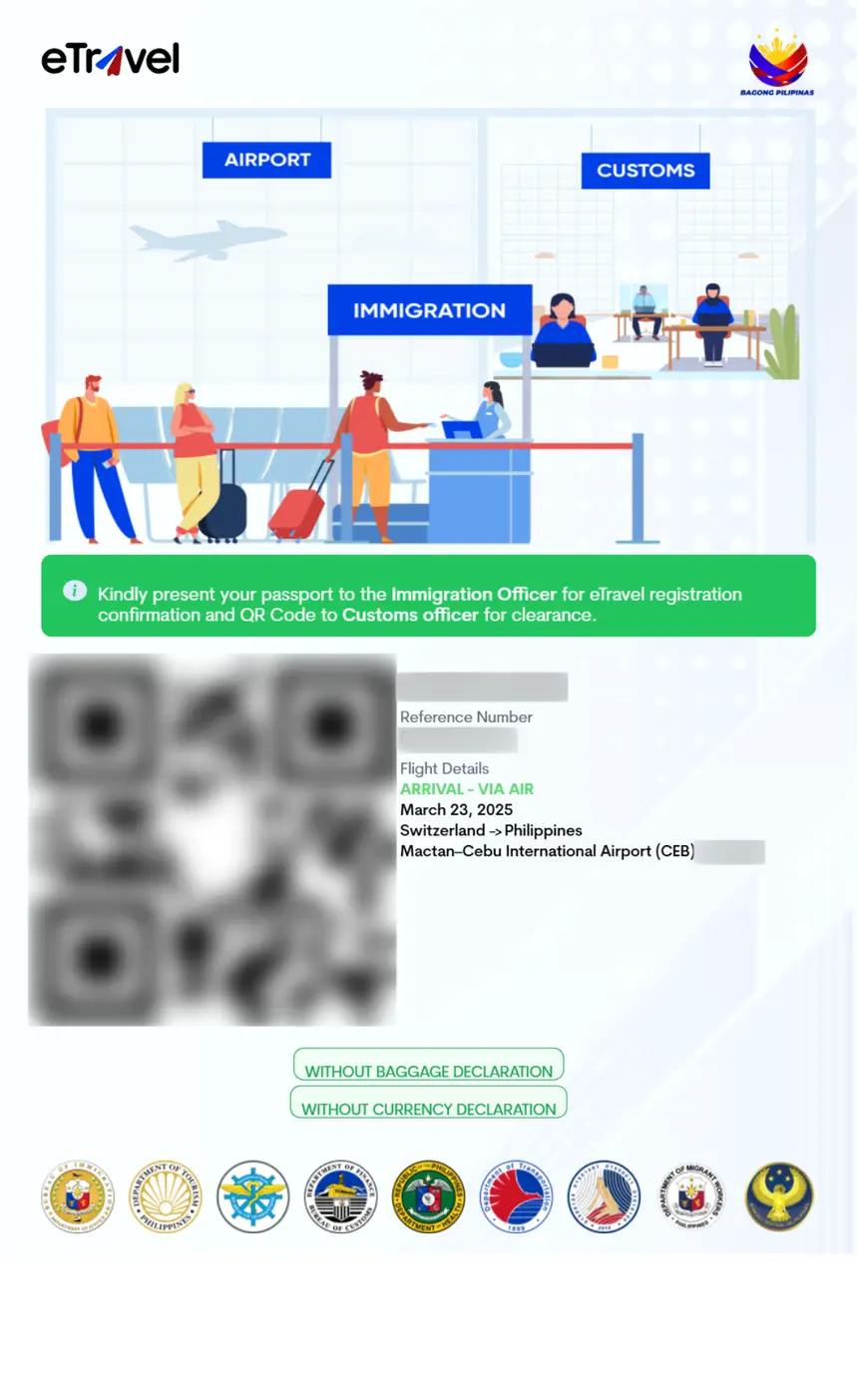
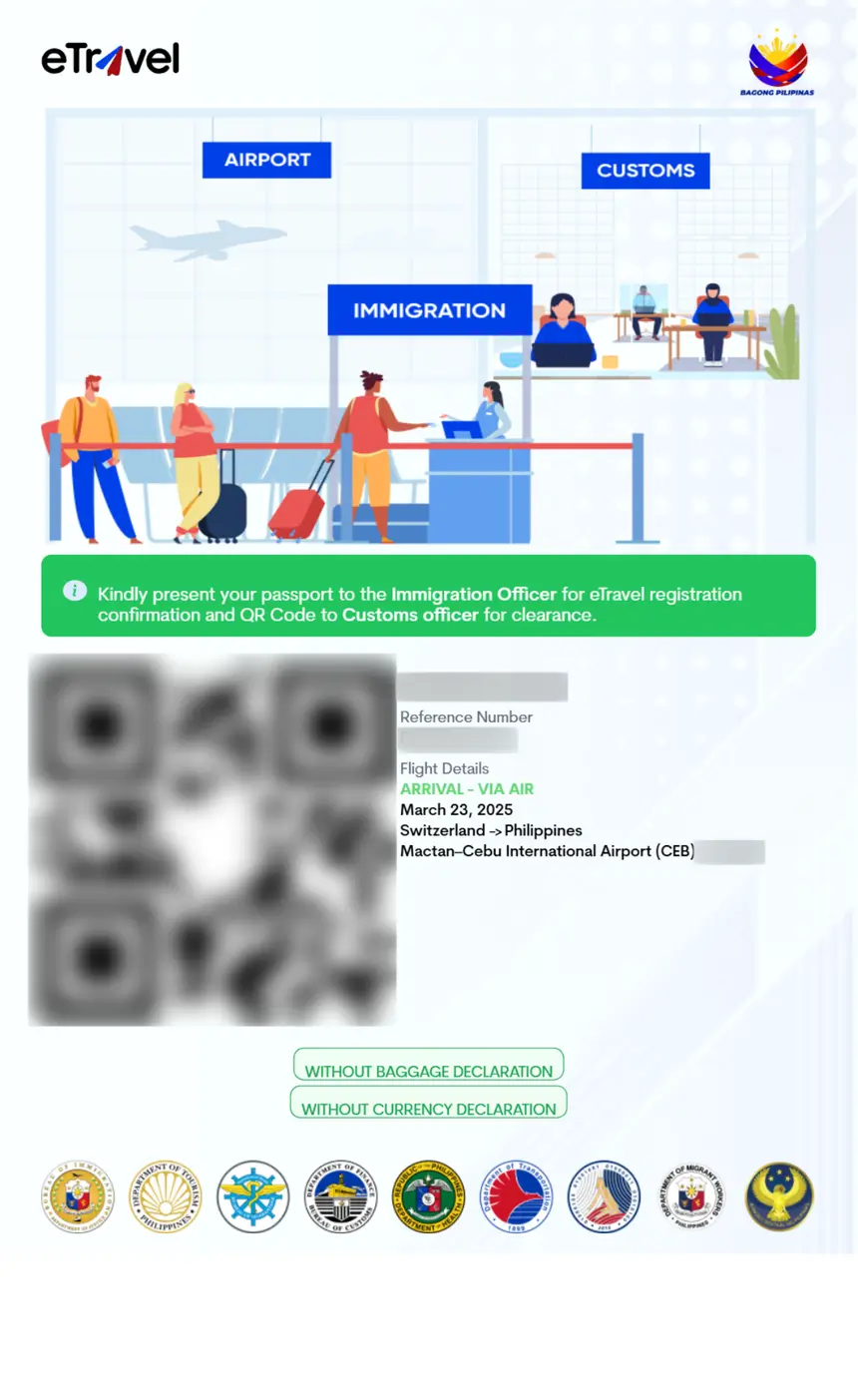
Regardless of visa status, all arriving foreign nationals must complete the eTravel registration before entering the Philippines. This digital system replaced the previous One Health Pass and paper arrival cards.
eTravel Requirements
- When to register: Within 72 hours before your arrival in the Philippines.
- Where to register: The official eTravel website (etravel.gov.ph). Registration is completely free.
- What you receive: A QR code that you must present to airline staff at check-in and to immigration officers upon arrival.
- Important: Some airlines will not allow you to board your flight without showing the eTravel QR code. Save a screenshot or download the QR code so you can access it without an internet connection.
- Beware of scams: Only use the official government website. Third-party sites may charge unnecessary processing fees.
Exit Requirements
Certain travelers may need additional documentation when leaving the Philippines:
- Emigration Clearance Certificate (ECC): If you have stayed in the Philippines for six months or more on a tourist visa, you must obtain an ECC within 72 hours before departure.
- Travel pass: Holders of visas issued by the Department of Justice, Board of Investments, or PEZA need a travel pass from the issuing department to exit the country. An ECC exempts you from this requirement.
- Airport tax: A departure tax of 850 Philippine pesos applies at Cebu Mactan Airport. Manila airport no longer charges a departure tax.
APEC Business Travel Card
Holders of a valid APEC Business Travel Card (ABTC) with the PHL code on the reverse may enter the Philippines visa-free for business trips lasting up to 59 days. This card is available to nationals of APEC member economies and streamlines business travel across the Asia-Pacific region.
Frequently Asked Questions
How many countries can visit the Philippines without a visa?
Nationals of 157 countries and territories can enter the Philippines without a pre-arranged visa. Most receive a 30-day visa-free stay, with some nationalities qualifying for 59 days or being limited to 14 days.
Can US citizens visit the Philippines without a visa?
Yes. US citizens can enter the Philippines visa-free for up to 30 days. Some sources indicate US passport holders may receive a 59-day stay upon arrival, though the standard visa-free allowance is 30 days with the option to extend.
Do I need a visa for the Philippines from the UK?
No. British citizens can visit the Philippines without a visa for tourism or business for up to 30 days. British Nationals (Overseas) passport holders from Hong Kong are limited to 7 days.
Can Indian citizens visit the Philippines without a visa?
Yes, since June 8, 2025. Indian nationals receive 14 days of visa-free entry. Those with valid visas or permanent residency from Australia, Canada, Japan, Schengen countries, Singapore, the UK, or the US qualify for 30 days.
Can Chinese citizens visit the Philippines without a visa?
Yes, since January 16, 2026. Chinese nationals may enter visa-free for up to 14 days for tourism or business. This temporary policy runs until January 15, 2027, and is limited to Manila and Cebu airports.
How long can a foreigner stay in the Philippines?
The maximum stay depends on your visa status. Visa-free visitors can stay up to their initial allowance (typically 30 days) and extend up to two years total. Visa-required visitors can extend up to six months total.
What is the eTravel registration?
eTravel is a mandatory digital registration system for all arriving foreign nationals. You must register at etravel.gov.ph within 72 hours before arrival. The system is free and generates a QR code required for boarding and immigration.
Can I extend my stay in the Philippines?
Yes. Visa-free nationals can extend by two months per extension up to two years total. Visa-required nationals can extend by one month per extension up to six months total. Extensions are processed at Bureau of Immigration offices or through the BI e-Services portal.
What passport validity do I need for the Philippines?
Your passport must be valid for at least six months beyond your intended period of stay in the Philippines.
Is travel insurance required for the Philippines?
Travel insurance is not a mandatory entry requirement, but it is strongly recommended. Medical treatment at private hospitals can be expensive, and emergency evacuation between islands can cost thousands of dollars.
Summary
The Philippines visa policy in 2026 is among the most traveler-friendly in Southeast Asia. With visa-free access extended to 157 countries, a growing eVisa system, and recent expansions covering Indian, Chinese, and Taiwanese nationals, the archipelago is more accessible than ever. All travelers should complete eTravel registration before departure, ensure their passport has at least six months of validity, and carry proof of onward travel. For longer stays, the Bureau of Immigration offers straightforward extension procedures that can keep you in the country for up to two years.