Understanding Philippine customs regulations before you land saves time, money, and stress at the airport. This guide covers duty-free allowances, declaration requirements, prohibited items, excess baggage duties, and the customs clearance process under the Customs Modernization and Tariff Act (CMTA).
How Philippine Customs Works
The Bureau of Customs (BOC) operates under Republic Act No. 10863, known as the Customs Modernization and Tariff Act (CMTA). Every traveler entering the Philippines must clear customs at the port of arrival. The process involves two stages: the primary inspection line, where your baggage passes through an X-ray machine, and the secondary inspection area, where officers may physically examine your luggage if something raises concern.
All goods imported into the Philippines are subject to duty and tax upon importation, unless specifically exempt under the CMTA or other laws. Importation begins the moment your aircraft enters Philippine airspace with the intention to land.
Duty-Free Allowances for Arriving Passengers
Filipino residents and non-resident travelers have different duty-free entitlements under Section 800 of the CMTA.
Filipino Residents (Returning Filipinos and OFWs)
| Category | Duty-Free Limit |
|---|---|
| Personal effects | Up to PHP 10,000 value |
| Used clothing and household items | Reasonable quantity for personal use |
| Wearing apparel and toiletries | For personal use only |
| Souvenirs and gifts | Up to PHP 10,000 combined value |
Returning overseas Filipino workers (OFWs) may bring in personal effects and household goods up to PHP 150,000 in value duty-free, provided the items are not in commercial quantity and have been used abroad for a specified period.
Non-Resident Foreign Travelers
| Category | Duty-Free Limit |
|---|---|
| Personal effects | Reasonable quantity for the duration of stay |
| Wearing apparel, toiletries | For personal use |
| Gifts and souvenirs | Up to PHP 10,000 value |
| One liter of alcohol | 1 bottle per adult |
| 200 cigarettes or 50 cigars | For personal consumption |
Commercial Goods
If you are bringing in goods of a commercial nature, different rules apply. Goods with a Free on Board (FOB) or Free Carrier (FCA) value of PHP 10,000 or below are exempt from duties and taxes under Section 423 of the CMTA. Goods valued between PHP 10,000 and PHP 50,000 may be processed as an informal entry, while goods above PHP 50,000 require a formal entry declaration.
Customs Declaration Form
All arriving passengers must complete a customs declaration form before reaching the inspection area. The form requires you to declare:
- Personal information (name, passport number, nationality)
- Flight number and port of entry
- Whether you are carrying goods exceeding duty-free limits
- Currency or monetary instruments totaling more than PHP 50,000 (or its foreign equivalent)
- Items purchased abroad
- Gifts intended for others
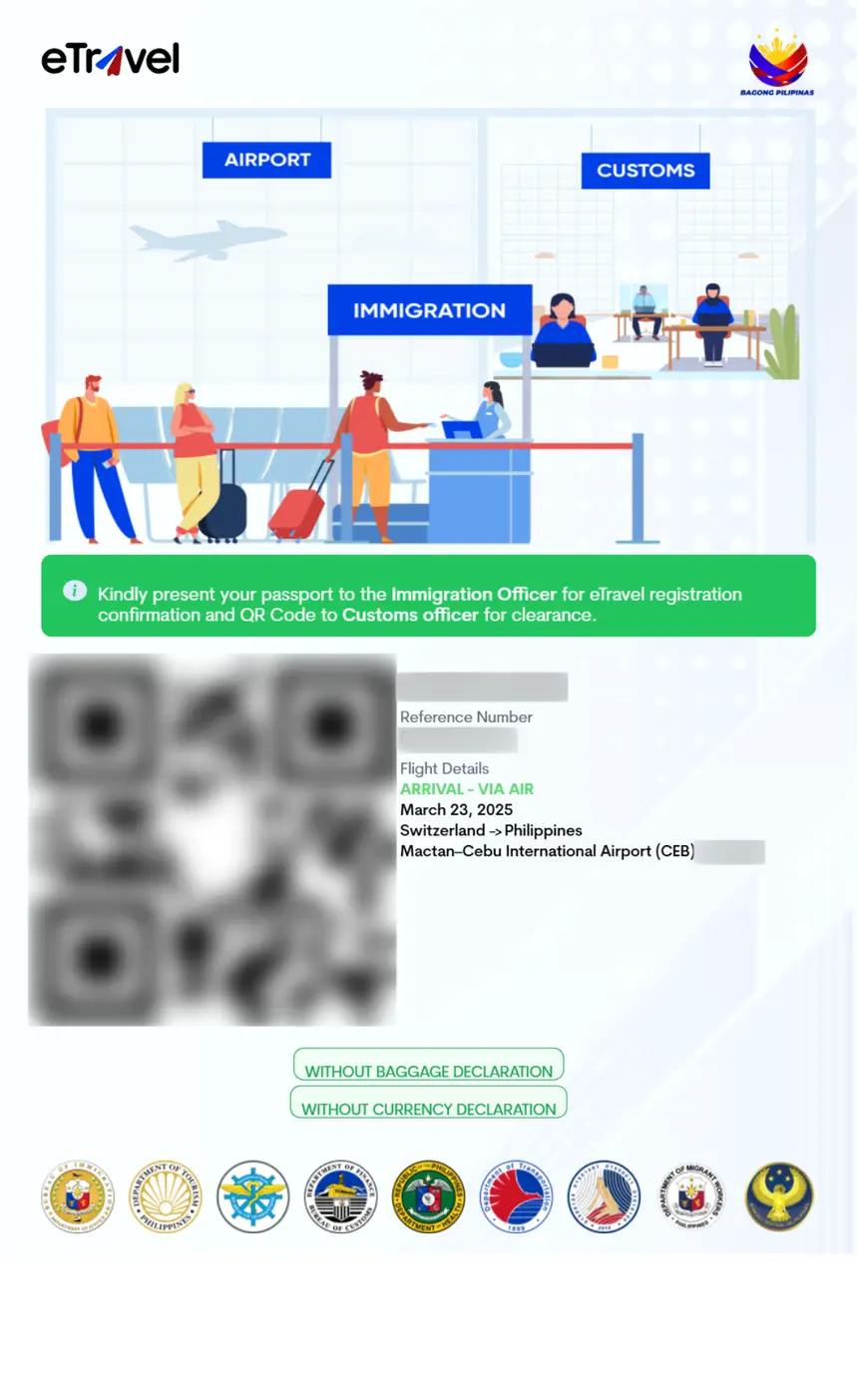
Since 2023, the Philippines has integrated customs declarations into the eTravel system (etravel.gov.ph), which replaces the traditional paper-based arrival card. Travelers should register on the eTravel platform at least 72 hours before arrival and complete the customs declaration section online.
Prohibited and Restricted Items
The Bureau of Customs strictly enforces restrictions on certain goods. Violations can result in seizure, fines, or criminal prosecution.
Absolutely Prohibited Items
These items cannot be imported into the Philippines under any circumstances:
- Illegal drugs and narcotics (marijuana, cocaine, heroin, methamphetamine)
- Drug paraphernalia
- Firearms, ammunition, and explosives (without PNP authorization)
- Pornographic materials
- Counterfeit currency and goods
- Gambling paraphernalia (without PAGCOR license)
- Hazardous waste and materials
- Goods bearing false trademarks
Restricted Items (Require Permits)
These items can be brought in only with prior authorization from the relevant government agency:
| Item | Required Permit/License |
|---|---|
| Firearms and ammunition | Philippine National Police (PNP) permit |
| Medicines and pharmaceuticals | Food and Drug Administration (FDA) clearance |
| Plants and planting materials | Bureau of Plant Industry (BPI) permit |
| Animals and animal products | Bureau of Animal Industry (BAI) permit |
| Fish and aquatic products | Bureau of Fisheries and Aquatic Resources (BFAR) permit |
| Chemicals and precursors | Dangerous Drugs Board (DDB) clearance |
| Cultural property and artifacts | National Museum of the Philippines permit |
| Radio equipment | National Telecommunications Commission (NTC) permit |
Currency and Monetary Instruments
There is no limit on the amount of foreign currency you can bring into the Philippines. However, you must declare amounts exceeding PHP 50,000 (or its foreign equivalent) on your customs declaration form. Failure to declare can result in seizure and penalties.
When leaving the Philippines, the same rule applies: amounts over PHP 50,000 must be declared. The Bangko Sentral ng Pilipinas (BSP) regulates cross-border currency movements.
Alcohol and Tobacco Allowances
Travelers aged 18 and above may bring in limited quantities of alcohol and tobacco duty-free:
- Alcohol: Up to 2 bottles (not exceeding 1 liter each) of wine, spirits, or other alcoholic beverages
- Tobacco: Up to 200 cigarettes, or 50 cigars, or 250 grams of pipe tobacco
Exceeding these limits requires payment of customs duties and excise taxes. The excise tax rates on tobacco products were significantly increased under the TRAIN Law (Republic Act No. 10963) and subsequent amendments.
Excess Baggage and Shipped Items
If your checked baggage exceeds the duty-free allowance, you will need to pay customs duties on the excess amount. The standard procedure is:
- Declare all items on your customs form honestly
- Proceed to the customs assessment counter if your goods exceed duty-free limits
- The officer assesses the applicable duties and taxes based on the item’s value and tariff classification
- Payment is made on-site at the designated payment counter
- Keep your official receipt for future reference
Duty rates vary by product category. You can use the Bureau of Customs Tax Estimator at customs.gov.ph/estimator to calculate approximate charges before you travel.
Online Shopping and Postal Imports
For goods ordered online and shipped to the Philippines via mail or courier, customs duties and taxes apply as follows:
- Goods with an FOB value of PHP 10,000 or below are exempt from duties and taxes
- Goods valued between PHP 10,000 and PHP 50,000 are processed as informal entries
- All imported goods are subject to 12% Value-Added Tax (VAT)
- Excise taxes apply to specific product categories (alcohol, tobacco, petroleum, automobiles)
Customs processing charges, documentary stamps, and container security fees may also apply under CAO 02-2025.
Duty-Free Shops at Philippine Airports
Philippine international airports (NAIA in Manila, Mactan-Cebu, Clark, Davao, etc.) have duty-free shopping areas operated by Duty Free Philippines (DFP). Purchases made at these shops are subject to their own rules:
- Arriving passengers can purchase goods at the Duty Free Fiesta Mall near the airport
- The personal shopping privilege allows purchases up to USD 1,000 per person per month
- Items purchased at DFP are separate from your regular duty-free baggage allowance
Tips for Smooth Customs Clearance
- Register on eTravel early: Complete your customs declaration online at etravel.gov.ph at least 72 hours before your flight to avoid delays at the airport.
- Keep receipts: Retain all purchase receipts for items bought abroad. This speeds up the assessment process if you exceed duty-free limits.
- Separate declaration items: Pack items that need to be declared in an accessible location in your luggage.
- Know before you pack: Check the Philippine National Trade Repository (pntr.gov.ph) if you are unsure whether a specific item requires an import permit.
- Declare honestly: False declarations can lead to seizure of goods, fines of up to the value of the goods, and potential criminal charges.
- Check the tariff finder: Visit the Philippine Tariff Commission’s finder at finder.tariffcommission.gov.ph to look up duty rates for specific products.
Penalties for Violations
The CMTA prescribes significant penalties for customs violations:
- Failure to declare goods: Fine of up to PHP 200,000 or imprisonment of up to 8 years
- Smuggling: Imprisonment of 8 to 12 years and fine equal to the value of the smuggled goods
- False declarations: Fine and possible imprisonment under the CMTA
- Importation of prohibited goods: Criminal prosecution under applicable laws
Frequently Asked Questions
Do I need to declare items for personal use?
Personal effects in reasonable quantities for your own use generally do not need to be declared if they fall within the duty-free allowance. However, items exceeding PHP 10,000 in total value must be declared.
Can I bring prescription medicine into the Philippines?
Yes, but you should carry a valid prescription from your doctor. Certain controlled medications may require additional clearance from the FDA. Bring medicines in their original packaging with proper labeling.
What happens if I fail to declare excess items?
Customs officers may select your baggage for inspection based on the Cargo Selectivity System. If undeclared items are found, you may face fines, seizure of goods, and potential legal action.
How do I track a package stuck in customs?
Use the BOC Parcel Tracking System at parceltracking.customs.gov.ph or PHILPOST tracking at tracking.phlpost.gov.ph for mail shipments.
Are there special allowances for diplomats?
Diplomatic personnel enjoy specific privileges under the Vienna Convention on Diplomatic Relations and Philippine law. Diplomatic bags and supplies may be exempt from duties as prescribed under Section 800 of the CMTA.
Official Resources
- Bureau of Customs: customs.gov.ph
- eTravel Registration: etravel.gov.ph
- Philippine Tariff Finder: finder.tariffcommission.gov.ph
- Tax Estimator: customs.gov.ph/estimator
- Philippine National Trade Repository: pntr.gov.ph
- BOC Parcel Tracking: parceltracking.customs.gov.ph
This guide is for informational purposes only. Customs regulations may change without notice. Always verify current rules with the Bureau of Customs before traveling.