
The Ninoy Aquino International Airport, commonly known as NAIA, is the primary gateway to the Philippines. Located in the cities of Pasay and Parañaque in Metro Manila, this airport handles over 47 million passengers annually and serves more than 90% of international flights entering the country. Whether you are arriving for a tropical holiday or departing after an unforgettable stay, understanding how NAIA works will save you time, money, and stress.
This comprehensive guide covers every terminal, ground transportation option, facility, and insider tip you need to navigate Manila’s busiest airport with confidence.
Overview of Ninoy Aquino International Airport (NAIA)
NAIA was originally built as a U.S. military facility called Nichols Field in the 1930s and became Manila International Airport in 1948. In 1987, it was renamed in honor of Benigno “Ninoy” Aquino Jr., an opposition leader who was assassinated on the airport tarmac in 1983.
Today, NAIA is operated by the New NAIA Infrastructure Corporation (NNIC) under the supervision of the Manila International Airport Authority (MIAA). The airport consists of four separate passenger terminals spread across different locations in Metro Manila. Unlike most international airports, these terminals are not connected by walkways, which makes knowing your terminal assignment absolutely essential before you travel.
Key facts about NAIA:
- Location: About 5 miles (8 km) south of Manila city center
- Terminals: 4 separate buildings
- Annual passengers: 47+ million (pre-pandemic peak)
- International routes: Direct flights to destinations across Asia, North America, the Middle East, and Europe
- Domestic routes: Comprehensive coverage of the Philippine archipelago
- IATA code: MNL
The Philippines also has Clark International Airport (CRK) located north of Manila in Pampanga province. Clark serves as an alternative hub, particularly for low-cost carriers and travelers heading to destinations in the northern Philippines.
NAIA Terminal Guide: Which Terminal Is Your Flight?
Each NAIA terminal serves different airlines and flight types. Confirming your terminal before heading to the airport is critical because the terminals are 1 to 4 kilometers apart and connected only by road.
Terminal 1 – International Gateway
Terminal 1 is located in Parañaque City and handles the majority of international flights operated by foreign carriers. It is one of the oldest terminals and has been undergoing renovations to modernize its facilities.
Airlines at Terminal 1 include:
- Japan Airlines
- Korean Air
- Malaysia Airlines
- Air China
- China Eastern Airlines
- Etihad Airways
- Turkish Airlines
Terminal 1 has immigration and customs for arriving international passengers, duty-free shops, currency exchange counters, restaurants, and a tourist information desk.
Terminal 2 – Philippine Airlines Domestic Hub
Terminal 2, also known as the Centennial Terminal, was opened in 1998 to celebrate the Philippine Centennial. This terminal is now used exclusively by Philippine Airlines (PAL) and its affiliate PAL Express for domestic flights. Previously, Terminal 2 also handled PAL international flights, but those operations have been redistributed to other terminals.
The terminal is divided into the North Wing and South Wing to organize passenger flow. If you are flying domestically with Philippine Airlines, you will use Terminal 2.
Terminal 3 – The Modern International and Domestic Hub
Terminal 3 is the newest, largest, and most modern terminal at NAIA. It handles a mix of both international and domestic flights and offers the best facilities among all four terminals.
Major airlines at Terminal 3 include:
- Cebu Pacific (primary hub for domestic and international)
- All Nippon Airways (ANA)
- Cathay Pacific
- Emirates
- Singapore Airlines
- AirAsia (international routes)
- United Airlines
Terminal 3 has a direct connection to the NAIA Expressway, providing faster road access to and from different parts of Metro Manila. The food court on the fourth floor is open to the public and features both local and international dining options.
Terminal 4 – Domestic Budget and Regional Flights
Terminal 4, also known as the Manila Domestic Terminal, is the oldest and smallest terminal. It serves domestic budget and regional flights operated by smaller carriers.
Airlines at Terminal 4 include:
- AirSWIFT
- Sunlight Air
- Other regional carriers
Terminal 4 has basic amenities but fewer options compared to the larger terminals. Its compact size can make check-in and boarding quicker. Be aware that Terminal 4 is quite far from the other terminals and can take 30 to 40 minutes to reach by car.
Airlines and Their Terminal Assignments
The following table provides a quick reference for the most common airlines and their typical terminal assignments at NAIA:
| Airline | Terminal | Route Type |
|---|---|---|
| Philippine Airlines | Terminal 2 | Domestic |
| PAL Express | Terminal 2 | Domestic |
| Cebu Pacific | Terminal 3 | Domestic and International |
| AirAsia | Terminal 3 | International (domestic at T2) |
| Emirates | Terminal 3 | International |
| Singapore Airlines | Terminal 3 | International |
| Cathay Pacific | Terminal 3 | International |
| All Nippon Airways | Terminal 3 | International |
| Japan Airlines | Terminal 1 | International |
| Korean Air | Terminal 1 | International |
| Malaysia Airlines | Terminal 1 | International |
| Air China | Terminal 1 | International |
| United Airlines | Terminal 3 | International |
| AirSWIFT | Terminal 4 | Domestic Regional |
| Sunlight Air | Terminal 4 | Domestic Regional |
Important: Airlines occasionally change terminal assignments. Always confirm your terminal on the day of travel by checking your airline’s website or the official NAIA information channels.
Inter-Terminal Transfers at NAIA
Since the terminals are not connected by walkways, transferring between them requires planning. Here are your options:
Free Airside Shuttle Bus
NAIA operates a free 24-hour airside shuttle bus that connects all four terminals. The shuttle runs every 15 minutes and uses internal roads inside the airport complex. You can find the shuttle bus pick-up and drop-off points at the ramp area of each terminal.
Key details:
– Free of charge
– Operates 24 hours, 7 days a week
– Runs every 15 minutes
– Uses internal airport roads to avoid traffic
– Available for passengers with connecting flights at another terminal
– You must clear immigration and customs before using the shuttle
Philippine Airlines Shuttle
Philippine Airlines operates its own free shuttle service between Terminal 2 and Terminal 3 for PAL passengers. This shuttle also uses the internal airport roads.
Taxi or Grab
You can also take a metered taxi or book a Grab ride between terminals. The distance between terminals ranges from 1 to 4 kilometers, with travel times of 10 to 20 minutes depending on traffic. Note that taxis use public roads, so rush hour can cause significant delays.
Terminal distance reference:
- Terminal 1 to Terminal 2: approximately 1 kilometer (walkable in 15 minutes, but not recommended with heavy luggage)
- Terminal 1 to Terminal 3: approximately 3 kilometers (10 to 15 minutes by car)
- Terminal 1 to Terminal 4: approximately 4 kilometers (30 to 40 minutes by car in traffic)
Tip: If you have a connecting flight between terminals, allow at least 3 hours between flights to account for immigration, customs, shuttle wait times, and potential traffic delays.
Ground Transportation: Getting To and From NAIA
Ride-Sharing Apps (Grab)
Grab is the most popular ride-sharing service in the Philippines and the recommended way to get from NAIA to your destination. It works similarly to Uber. The fare is determined upfront through the app, eliminating meter disputes.
How to use Grab at NAIA:
– Download the Grab app before your trip
– Add a valid credit or debit card, or choose to pay cash
– Follow the signs to the designated Grab pick-up bays outside the arrival area
– Verify the car plate number and driver before entering the vehicle
– Grab fares from NAIA to Makati typically cost around 250 to 500 Philippine Pesos (approximately USD 4 to 9)
If you do not have a smartphone or internet connection, Grab booking agents may be available at booths near the terminal exits. All four terminals have free Wi-Fi you can use to download and set up the app.
Taxis
Three types of taxis operate at NAIA:
Yellow Airport Taxis are officially accredited metered taxis with a flag-down rate of 70 Philippine Pesos. They are easily identified by their distinct yellow color and are available outside all terminals. They charge approximately 50% more than regular white taxis.
White City Taxis are regular metered taxis with a flag-down rate of 40 Philippine Pesos. They are available at taxi stands near the terminals. Always ensure the meter is running and the driver has a visible license.
Coupon Taxis charge a fixed rate based on your destination. You receive a coupon at the dispatch station that shows the flat rate. This eliminates any meter disputes and is a good option if you want price certainty before the ride begins.
UBE Express Airport Bus
The UBE Express (Ultimate Bus Experience) premium airport bus connects all NAIA terminals to key points in Metro Manila, including major hotels, malls, and tourist areas. The standard fare is 300 Philippine Pesos (approximately USD 6) per person.
UBE Express schedules:
– Terminal 1: 8:00 AM to 10:00 PM, Main Arrivals area
– Terminal 2: 8:00 AM to 10:00 PM, Arrivals Bay 17
– Terminal 3: 24 hours, Arrivals Bay 14
– Terminal 4: 8:00 AM to 10:00 PM, Arrivals exit
Routes include stops at SM Mall of Asia, Solaire Resort, Makati (Ayala Center), Robinsons Manila, Intramuros, and Araneta Center in Cubao.
Regular City Buses
Air-conditioned city buses connect NAIA terminals to major destinations via EDSA (Metro Manila’s main highway). The fare is a flat 100 Philippine Pesos (approximately USD 2). Buses run every 15 to 20 minutes starting from Terminal 3, then picking up passengers at Terminals 1, 2, and 4.
Jeepneys
The iconic Philippine jeepney is the cheapest transport option from NAIA. Routes include Nichols-Vito Cruz-EDSA-Tramo, Baclaran-MIA, and Domestic Airport-Baclaran-South Pier. Jeepneys are not recommended for travelers with heavy luggage or those unfamiliar with the local transit system.
Car Rentals
Car rental companies have booths in the arrival halls of all terminals. You can book in advance online or approach their desks upon arrival. The Philippines is a left-hand-drive country.
Facilities and Amenities Inside NAIA
Free Wi-Fi
All NAIA terminals offer free Wi-Fi. Connect to the GlobeFreeWiFi@NAIA network and register with your phone number to access unlimited internet during your stay at the airport.
Shopping and Dining
Terminal 3 offers the most variety in shopping and dining. The food court on the fourth floor features local Filipino restaurants, international fast-food chains, and coffee shops. Notable options include:
- Jollibee – the beloved Filipino fast-food chain, available in Terminals 1, 2, and 3
- Bo’s Coffee – a popular local coffee chain
- Duty Free Philippines – outlets in Terminals 1, 2, and 3 offering tax-free liquor, chocolates, and souvenirs
- National Book Store – for books, travel essentials, and reading material
- Tesoro’s Philippine Handicrafts – for authentic Filipino souvenirs and handcrafted items
Airport Lounges
Several lounges are available across the terminals for business and first-class passengers, loyalty program members, and credit card holders. Pay-per-use lounges are also available for all passengers.
- Skyview Lounge – available in Terminals 1 and 3
- PAGSS Lounge – available in Terminals 1 and 3, offering buffet spreads, Wi-Fi, and comfortable seating
- The Wings Transit Lounge – located in Terminal 3, offers sleeping facilities including lounge chairs, sleeping capsules, and private rooms for a fee. Ideal for passengers with long layovers.
Currency Exchange and ATMs
Money changers are located in the international arrival and departure areas of Terminals 1 and 3. Rates at the airport are competitive. ATMs are available across all terminals, mostly landside before security. It is recommended to withdraw Philippine Pesos before proceeding to immigration, as many smaller shops and services in the Philippines only accept cash.
Baby Care and Medical Facilities
All terminals have baby changing facilities. Medical clinics and pharmacies are available inside the airport for passengers who need basic healthcare services or medication.
Arrival Process at NAIA
When arriving at NAIA on an international flight, you will follow this process:
- Disembark and follow signs to the immigration hall
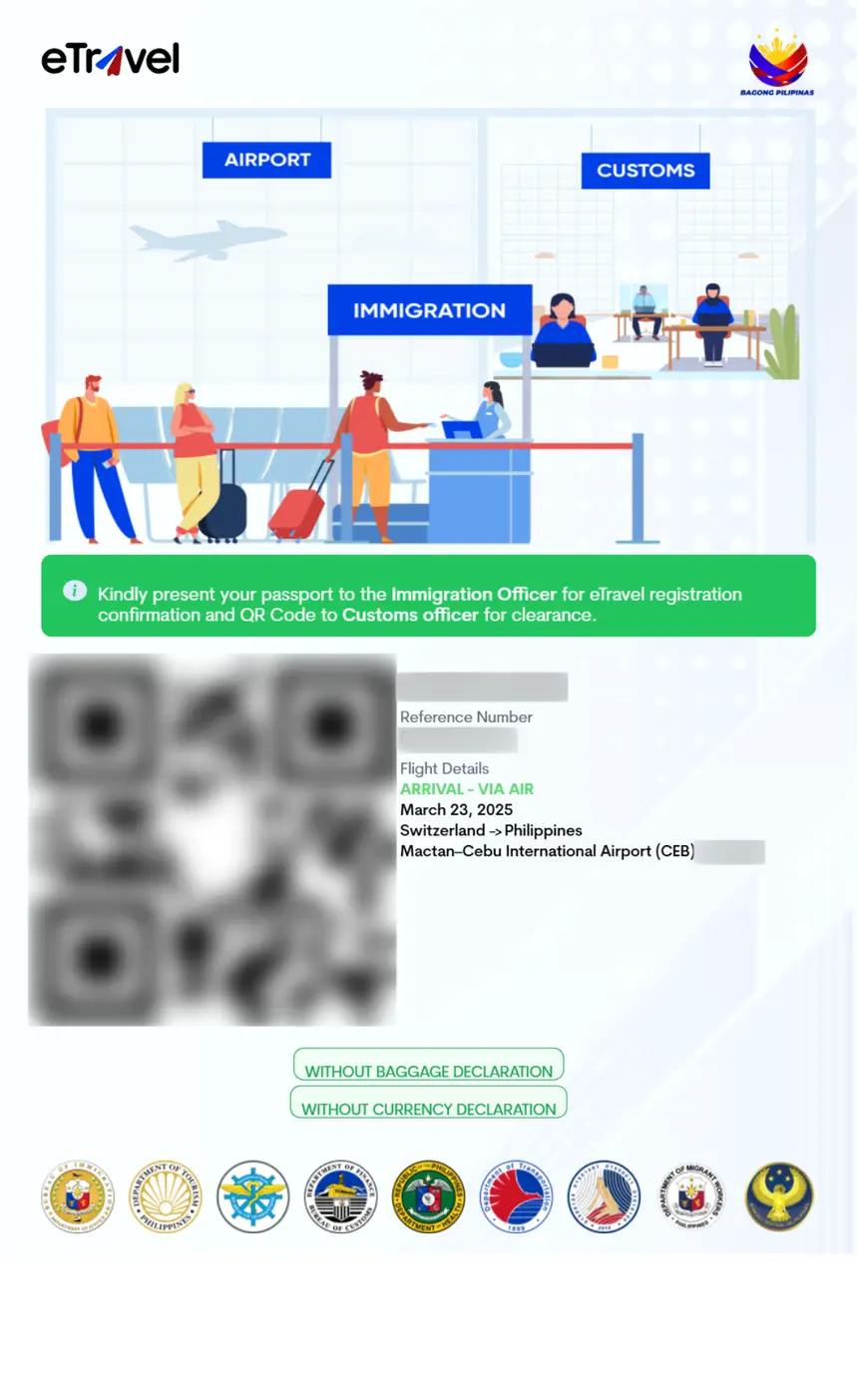
- Present documents at the immigration counter – passport, visa (if required), and your eTravel registration confirmation
- Collect luggage from the baggage carousel indicated on the flight information screens
- Clear customs – your bags may be screened via X-ray. Declare any dutiable items
- Exit to the arrivals hall where you will find currency exchange, SIM card booths (Globe and Smart), transportation counters, and tourist information
Processing time: Immigration and customs can take 30 minutes to over 2 hours, depending on the time of day and passenger volume. Peak hours typically coincide with the arrival of multiple long-haul flights.
Departure Process at NAIA
For departing passengers, the process is:
- Complete your eTravel registration at etravel.gov.ph or through the eGovPH app up to 72 hours before your flight
- Arrive at the correct terminal – at least 3 hours before international flights and 2 hours before domestic flights
- Pass the initial security check at the terminal entrance (only passengers with valid travel documents are allowed inside)
- Check in at your airline’s counter – drop off luggage and receive your boarding pass
- Proceed through immigration – present your passport, boarding pass, and eTravel QR code
- Final security screening before entering the pre-departure area
- Find your boarding gate and wait for your flight
eTravel registration is mandatory for all departing Filipino citizens and departing foreign nationals. Without a completed eTravel form, you may be denied check-in or refused at immigration.
Hotels Near NAIA for Layovers
Newport City, located directly across from Terminal 3 and connected by the Runway Manila pedestrian bridge, is the most convenient area for airport hotels. Options include:
- Marriott Hotel Manila – luxury option with premium amenities
- Belmont Hotel Manila – mid-range with excellent convenience
- Holiday Inn Express Manila Newport City – budget-friendly with good value
- Go Hotels Manila Airport Road – affordable option near the airport
For in-airport rest, The Wings Transit Lounge in Terminal 3 provides sleeping capsules and private rooms that can be booked for a few hours or overnight.
Tips for First-Time Travelers at NAIA
- Confirm your terminal before leaving your hotel. Going to the wrong terminal at NAIA can cost you 30 to 40 minutes in traffic and potentially cause you to miss your flight.
- Allow extra travel time to the airport. Manila traffic is notoriously unpredictable. A drive that takes 30 minutes in light traffic can take over 2 hours during rush hour.
- Use the toll highway (NAIA Expressway) when heading to Terminal 3. It costs about 1 USD but can save significant time.
- Only take yellow airport taxis or Grab. Avoid white taxis unless you are comfortable ensuring the meter is running. Coupon taxis are also a safe option with fixed pricing.
- Exchange money at the airport. Rates at NAIA are competitive and often better than what you will find at smaller money changers in the provinces.
- Get a local SIM card at the arrival hall. Globe and Smart booths are available in all terminals. A prepaid SIM with data costs around 100 to 300 Philippine Pesos.
- Print your return or onward flight ticket. Immigration officers may request to see proof of onward travel.
- Keep your eTravel QR code ready. Both arriving and departing passengers must present their eTravel registration at immigration.
- Do not use unofficial porters. Only accept assistance from uniformed airport staff to avoid scams and overcharging.
- Stay hydrated and carry snacks. Queues can be long, and having water and light food in your carry-on ensures comfort during waits.
Frequently Asked Questions
Which terminal does Cebu Pacific use at NAIA?
Cebu Pacific operates from Terminal 3 for both domestic and international flights. This is the newest and largest terminal at NAIA.
How do I transfer between NAIA terminals?
Use the free 24-hour airside shuttle bus that runs every 15 minutes between all four terminals. Alternatively, take a taxi or Grab ride, but allow extra time during rush hour. Terminal 1 and Terminal 2 are approximately 1 kilometer apart and can be reached on foot in about 15 minutes.
How early should I arrive at NAIA for an international flight?
Arrive at least 3 hours before your scheduled international departure. This allows time for the initial security check, check-in, immigration, and the final security screening. During peak travel seasons, consider arriving even earlier.
Is there free Wi-Fi at NAIA?
Yes, all NAIA terminals offer free Wi-Fi through the GlobeFreeWiFi@NAIA network. Register with your phone number to connect.
Can I sleep at NAIA during a long layover?
Yes. The Wings Transit Lounge in Terminal 3 offers sleeping capsules, lounge chairs, and private rooms for a fee. Several hotels in Newport City, directly connected to Terminal 3 via the Runway Manila pedestrian bridge, also offer day-use and overnight rates.
Do I need eTravel to depart from the Philippines?
Yes. eTravel registration is mandatory for all departing passengers, including Filipino citizens and foreign nationals. Complete your registration at etravel.gov.ph or through the eGovPH mobile app up to 72 hours before your flight.
What is the cheapest way to get from NAIA to Manila city center?
The cheapest option is a regular city bus at 100 Philippine Pesos (approximately USD 2). Jeepneys are even cheaper but not recommended for travelers with luggage. For the best balance of cost and convenience, take a yellow airport taxi or Grab ride, which costs around 200 to 500 Philippine Pesos depending on your destination.
Are there currency exchange facilities at NAIA?
Yes. Money changers are available in the international arrival and departure areas of Terminals 1 and 3. ATMs are located across all terminals, mostly before the security checkpoints. Rates at the airport are generally competitive.
How many airports are in the Philippines?
The Philippines has 14 international airports and 26 domestic airports spread across the archipelago. Besides NAIA in Manila, major international airports include Clark International Airport (CRK) in Pampanga, Mactan-Cebu International Airport (MCIA) in Cebu, and Francisco Bangoy International Airport in Davao.