

If you overstay your visa in the Philippines, you face an administrative fine of PHP 500 per month of overstay, plus mandatory visa extension fees, an Alien Certificate of Registration (ACR) I-Card, and possible deportation or blacklisting for serious violations. The Bureau of Immigration (BI) actively enforces immigration rules under the Philippine Immigration Act (RA 613) and the Alien Registration Act (RA 562). This guide breaks down every penalty, fee, and consequence so you know exactly what to expect if you have overstayed or are at risk of doing so.
What Counts as Overstaying in the Philippines?
Overstaying occurs when a foreign national remains in the Philippines beyond the period authorized by their visa or visa-free entry. For most tourists from visa-free countries, the initial authorized stay is 30 days. If you do not apply for an extension before that period expires, you are technically overstaying starting on day 31.
Key points:
- The 30-day count begins on the date of your arrival stamp, not the date you booked your flight.
- Even a single day past your authorized stay counts as overstaying.
- The Bureau of Immigration tracks your status through arrival and departure records at all ports of entry.
If you are unsure about whether you need a visa at all, check the Philippines visa-free countries list. Understanding the difference between an authorized stay and an expired one is critical. If you plan to stay longer than 30 days, you must extend your visa at a BI office before your current period expires. You can also learn more about Philippines visa requirements before your trip.
Administrative Fines for Overstaying
The Bureau of Immigration imposes a straightforward monthly fine structure for overstaying foreign nationals. These fees are set by BI Memorandum Circulars and are updated periodically.
Fine Schedule
| Penalty Component | Amount (PHP) | Notes |
|---|---|---|
| Overstay Fine | 500 per month | Charged for each month or fraction thereof |
| Motion for Reconsideration | 500 | If you contest the overstay finding |
| Visa Waiver Application Fee | 1,000 | Required when applying for extension after overstay |
| Visa Waiver Fee | 500 | Processing fee for the waiver itself |
| Certification Fee | 500 | Clearance certification |
| Legal Research Fee | 30 | Applied per immigration fee |
| Express Fee | 1,000 | Expedited processing surcharge |
These amounts are based on the BI’s official fee schedule as published on the Bureau of Immigration website. Fees may change without prior notice, so always verify the current schedule at a BI office before paying.
Real-World Cost Example
If you overstay by 3 months as a tourist from a visa-free country, your total settlement cost would include:
- Overstay fine: PHP 1,500 (3 months x PHP 500)
- Visa waiver fees: approximately PHP 3,030 (including application, certification, express, and legal research fees)
- ACR I-Card: USD 50 (approximately PHP 2,800) if your stay exceeded 59 days
- Total estimated cost: PHP 7,330 to PHP 8,500+
The longer you overstay, the higher the cumulative fines. A 12-month overstay would add PHP 6,000 in fines alone on top of all other fees.
Additional Fees for Extended Stays Beyond 59 Days
If your total stay in the Philippines exceeds 59 days, you are required to obtain an Alien Certificate of Registration (ACR) I-Card. This applies whether or not you overstayed. The ACR I-Card costs USD 50 and must be renewed annually.
For adults (16 years and older), additional fees include:
| Fee Component | Amount |
|---|---|
| Extension Fee | PHP 500-1,000 per month |
| Application Fee | PHP 300 |
| ACR Fee | PHP 1,000 |
| Head Tax (over 16) | PHP 250 |
| Certification Fee | PHP 500 |
| Express Fee | PHP 1,000 |
| ECC Fee | PHP 700 |
| Legal Research Fee | PHP 50 |
| Visa Sticker Fee | PHP 100 |
Minors under 14 pay reduced ACR fees (PHP 500 instead of PHP 1,000) and are exempt from the head tax.
Deportation and Blacklisting
Beyond financial penalties, serious or prolonged overstays carry far more severe consequences:
Deportation – The BI can issue a Summary Deportation Order against foreign nationals who overstay significantly. Under Section 37 of RA 613, the Commissioner of Immigration has the authority to deport any alien who violates immigration laws, including those who overstay their visa.
Blacklisting – Once deported or ordered to leave, your name may be placed on the BI’s blacklist. This prevents you from re-entering the Philippines, sometimes permanently. Blacklisted individuals are stopped at immigration upon arrival and turned away.
Detention – In extreme cases, the BI can detain overstaying aliens pending deportation proceedings. Detention facilities are not comfortable, and the process can take weeks or months depending on case complexity.
Criminal Prosecution – Under Section 45 of RA 613, willful overstay can be prosecuted as a criminal offense, carrying penalties of imprisonment of up to 10 years and fines of up to PHP 10,000. While criminal prosecution is rare for simple overstay cases, it is more likely when combined with other violations such as using fraudulent documents or working without authorization.
How to Settle an Overstay
If you have overstayed, the process to regularize your status involves several steps at a Bureau of Immigration office:
- Visit the nearest BI office (Main Office in Intramuros, Manila, or regional offices).
- Secure and fill out the CGAF (Consolidated General Application Form).
- Submit your completed form, passport, and supporting documents to the frontline officer.
- If you have no derogatory records, a BI Clearance Certificate is issued. Otherwise, proceed to the Verification and Certification Unit.
- Get an Order of Payment Slip and pay all assessed fees at the Cashier.
- Submit the Official Receipt with your application to the receiving officer.
- Claim your passport stamped with the regularization of your stay.
The entire process typically takes 1-2 business days at the main office, though express processing is available for an additional fee.
What Happens at the Airport If You Overstayed?
If you attempt to leave the Philippines with an expired visa, immigration officers at the airport will:
- Flag your record during departure immigration processing.
- Calculate your total overstay period and assess the corresponding fines.
- Require you to pay all outstanding fines and fees before allowing departure.
- In some cases, issue a hold departure order that prevents you from leaving until the matter is resolved.
You cannot simply leave the country to “reset” your overstay. The BI records all arrivals and departures, and unpaid fines will follow you. If you refuse to pay, you may be detained.
How to Avoid Overstaying
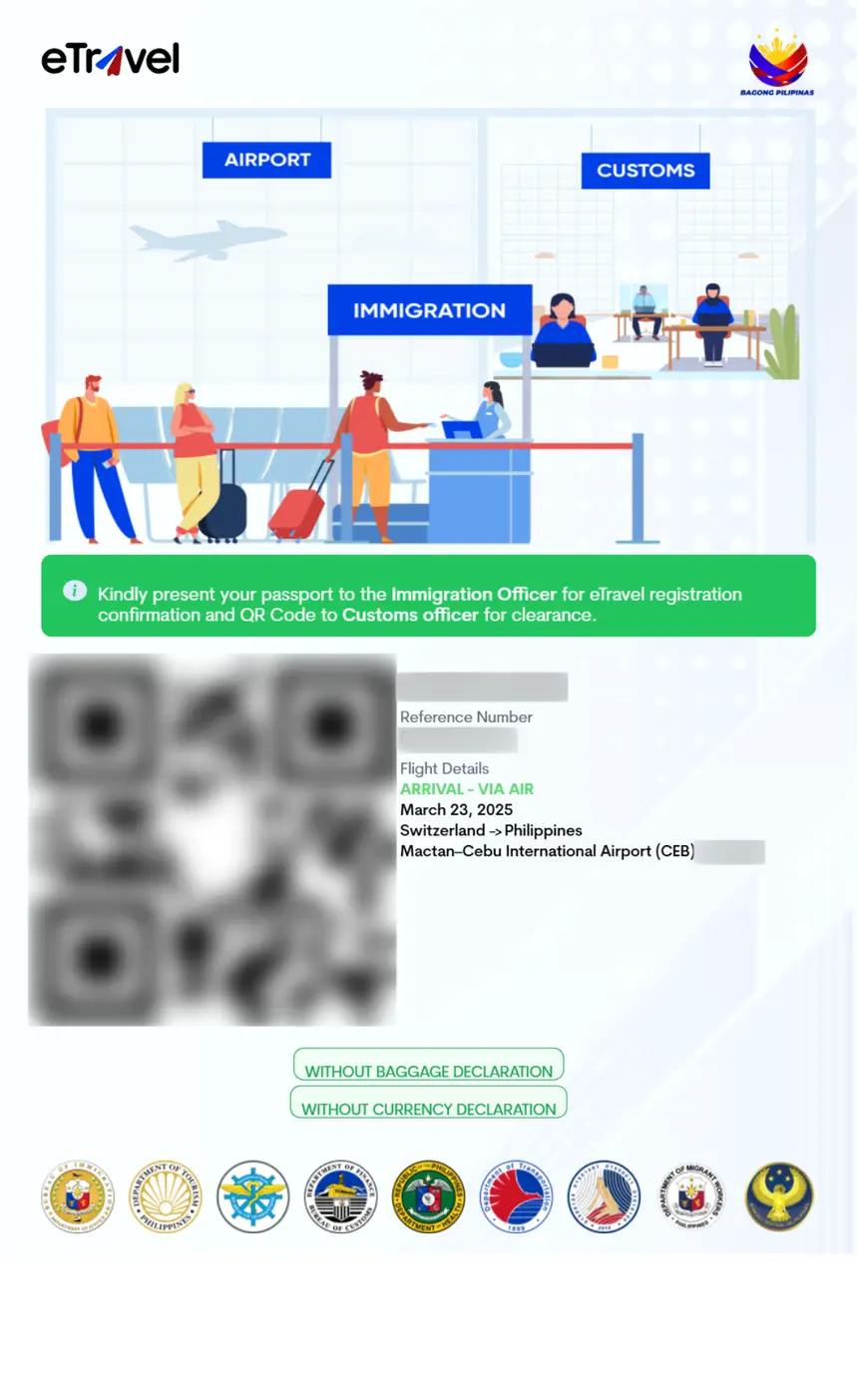
Before traveling, make sure you have completed your eTravel pass registration. The simplest way to avoid overstay penalties is to manage your visa status proactively:
- Track your authorized stay period carefully. Mark the expiration date on your calendar.
- Apply for extensions before your current period expires, not after.
- Use the BI eServices portal for online visa extension applications.
- Set up a calendar reminder 5-7 days before your visa expires.
- If you are unsure about your status, visit a BI office for clarification.
- Consider the eTravel registration requirements as part of your travel planning.
Frequently Asked Questions About Philippines Overstay
How much is the overstay fine per day in the Philippines?
The Bureau of Immigration charges a flat rate of PHP 500 per month of overstay, not per day. Even a fraction of a month counts as a full month for fine calculation purposes. So whether you overstay by 1 day or 30 days in a given month, the fine is the same PHP 500 for that month.
Can I go to jail for overstaying in the Philippines?
Simple overstay alone rarely leads to jail time. However, under Section 45 of the Philippine Immigration Act (RA 613), willful violation of immigration laws can carry imprisonment of up to 10 years. Criminal prosecution is more likely when overstay is combined with other violations such as fraud, illegal work, or use of fake documents.
What happens if I overstay by just one day?
Even a one-day overstay technically makes you liable for a PHP 500 fine for that month. In practice, immigration officers may show leniency for very short overstays of 1-2 days, but you should not count on this. It is always safer to extend your visa before it expires.
Can I be deported for overstaying?
Yes. The Bureau of Immigration can issue a Summary Deportation Order for foreign nationals who significantly overstay their authorized period. Deportation is more common for overstays of 6 months or longer, but the BI has discretion to deport for shorter periods depending on the circumstances.
Will overstaying affect my ability to return to the Philippines?
Yes, potentially. If you are deported or blacklisted, you may be barred from re-entering the Philippines. Even if you settle your overstay without deportation, a record of overstay may cause immigration officers to scrutinize your future entries more closely.
Can I extend my visa after it has already expired?
Yes, but you will incur the overstay fine in addition to the regular extension fees. The process is called a “Visa Waiver” and requires visiting a BI office in person. The overstay fine of PHP 500 per month will be assessed on top of the standard extension charges.
What is the maximum penalty for overstaying in the Philippines?
The maximum penalty under RA 613 is imprisonment of up to 10 years and a fine of up to PHP 10,000. Additionally, deportation and permanent blacklisting from the Philippines may apply. In practice, most overstayers face administrative fines rather than criminal prosecution.
Do I need an ACR I-Card if I overstay?
If your total stay in the Philippines exceeds 59 days, you are required to obtain an ACR I-Card regardless of overstay status. The card costs USD 50. If you overstayed without having obtained the card, you will need to pay for it as part of your regularization process, on top of overstay fines.
Key Takeaways
Overstaying in the Philippines is a serious matter handled by the Bureau of Immigration under RA 613 and RA 562. The financial penalties start at PHP 500 per month and escalate with additional fees for visa waivers, ACR I-Cards, and certifications. For prolonged overstays, consequences can include deportation, blacklisting, and even criminal prosecution. The best strategy is always to track your visa expiration date carefully and apply for extensions through the BI eServices portal or at any BI office before your authorized stay expires.