
What Is the Philippines Travel Tax
The Philippines travel tax is a departure levy imposed by the Philippine government on individuals leaving the country, regardless of where the airline ticket was purchased or how it was paid. Established under Presidential Decree (PD) 1183, as amended, the tax is collected and administered by the Tourism Infrastructure and Enterprise Zone Authority (TIEZA).
The travel tax funds tourism infrastructure development and heritage conservation programs across the Philippines. Every departing passenger – whether flying economy or first class – must either pay the travel tax, qualify for a reduced rate, or obtain an exemption before boarding their flight.
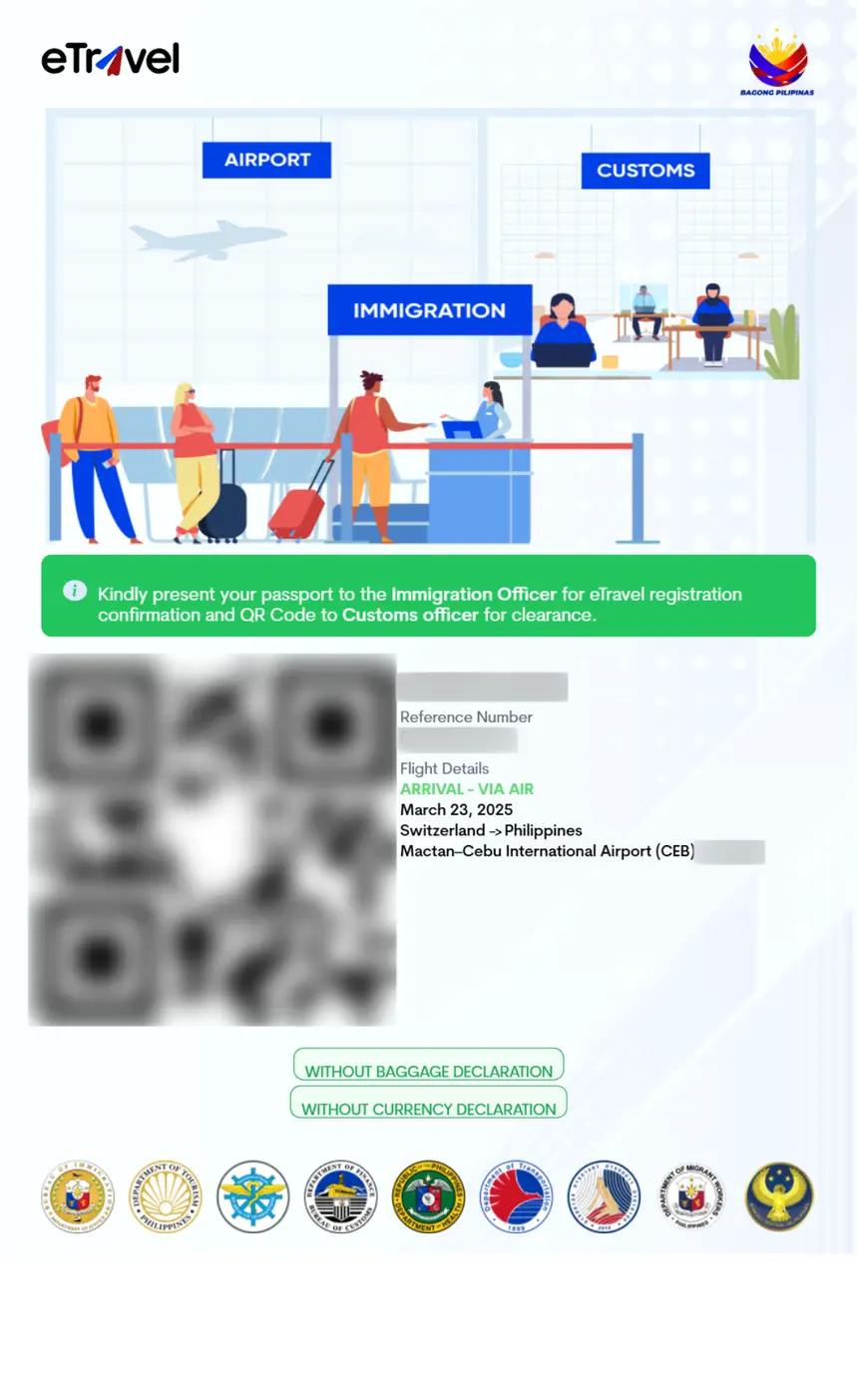
The tax applies at all international airports in the Philippines, including Ninoy Aquino International Airport (NAIA) in Manila, Clark International Airport, Mactan-Cebu International Airport, and other gateway airports. If you are completing your eTravel registration before departure, the travel tax is a separate requirement that you handle independently.
How Much Is the Philippines Travel Tax
The Philippines travel tax follows a three-tier rate structure based on the passenger’s eligibility category and cabin class. Here are the current TIEZA rates:
| Travel Tax Category | First Class Passage | Economy Class Passage |
|---|---|---|
| Full Travel Tax | PHP 2,700 | PHP 1,620 |
| Standard Reduced Travel Tax | PHP 1,350 | PHP 810 |
| Privileged Reduced Travel Tax (OFW dependents) | PHP 400 | PHP 300 |
Most Filipino tourists and citizens pay the Full Travel Tax of PHP 1,620 for economy class or PHP 2,700 for first class. These rates have been in effect since TIEZA’s last update and are consistent across all Philippine international airports.
The Standard Reduced Travel Tax applies to specific categories such as children aged 2 years and 1 day up to their 12th birthday. The Privileged Reduced Travel Tax is reserved for qualified dependents of Overseas Filipino Workers (OFWs) travelling to the OFW’s worksite.
If you are budgeting for your trip, factor in the Philippines visa fee alongside the travel tax, as both are separate costs that may apply depending on your nationality and visa type.
Who Must Pay the Philippines Travel Tax
The Philippines travel tax is required for the following categories of departing passengers:
- Filipino citizens – all Filipino passport holders must pay regardless of destination or ticket origin
- Permanent resident aliens – foreign nationals holding permanent resident status in the Philippines (Section 13 visa categories, RA 7919, and similar)
- Non-immigrant foreign passport holders who have stayed in the Philippines for more than one year
The tax applies irrespective of where the air ticket was issued or the form of payment. Even if you purchased your ticket abroad, the Philippines travel tax still applies if you fall into one of the taxable categories.
For full travel tax payment, TIEZA requires the traveller’s original passport and airline ticket or booking confirmation. Review the Philippines entry requirements to ensure all departure documents are in order.
Who Is Exempt from the Philippines Travel Tax
Several categories of travellers are exempt from paying the Philippines travel tax under Section 2 of PD 1183, as amended. The main exempt groups include:
- Overseas Filipino Workers (OFWs) – hired through POEA or with authenticated employment contracts
- Filipino permanent residents abroad whose stay in the Philippines is less than one year
- Infants aged 2 years and below on the date of travel
- Foreign diplomatic and consular officials and their staff (requires DFA certification)
- United Nations officials, consultants, and employees (UN passport or employment certification required)
- US military personnel and dependents with government-funded travel (GTR required)
- Crewmembers of international aircraft (CAB certification required)
- Philippine government officials travelling on official business (Travel Authority required)
- Scholarship grantees with approved scholarships from appropriate government agencies
- Balikbayans whose stay in the Philippines is less than one year (under R.A. 6768)
- Personnel of multinational companies with regional headquarters in the Philippines (BOI certification)
Each exemption category requires specific documentation presented at a TIEZA counter or submitted through the online portal. Always bring your original passport regardless of exemption type. If you hold a Philippines visa that qualifies for exemption, ensure you carry supporting proof of your immigration status.
Reduced Travel Tax for Children and OFW Dependents
Not every passenger pays the full Philippines travel tax. Two reduced-rate categories offer significant savings for eligible travellers.
Standard Reduced Travel Tax for Children
Children from 2 years and 1 day old up to their 12th birthday on the date of travel qualify for the Standard Reduced Travel Tax:
| Cabin Class | Reduced Rate |
|---|---|
| First Class Passage | PHP 1,350 |
| Economy Class Passage | PHP 810 |
This represents a 50% discount off the full travel tax rate. Infants who are 2 years old and below may be fully exempt instead.
Privileged Reduced Travel Tax for OFW Dependents
Qualified dependents of OFWs travelling to the OFW’s worksite may pay the Privileged Reduced Travel Tax:
| OFW Dependent | First Class | Economy Class |
|---|---|---|
| Legitimate spouse of an OFW | PHP 400 | PHP 300 |
| Unmarried children below 21 years old | PHP 400 | PHP 300 |
| Children with disabilities (subject to TIEZA requirements) | PHP 400 | PHP 300 |
To qualify, the dependent must be travelling to the OFW’s worksite and present the OFW’s employment documentation. The OFW themselves is fully exempt – the privileged rate applies only to their listed dependents.
How to Pay the Philippines Travel Tax Online
You can pay the Philippines travel tax online through TIEZA’s Online Travel Tax Services System (OTTSS), operated in partnership with MYEG Philippines. The system allows payment without account registration.
Step-by-step online payment guide:
- Check your ticket first – verify whether travel tax has already been included in your airline fare (see the next section for detection methods)
- Visit the TIEZA OTTSS portal at the official TIEZA website
- Select your service type – full travel tax, reduced travel tax, exemption application, or refund
- Enter passenger details – full name, passport number, nationality
- Enter flight information – airline, flight number, departure date, destination
- Upload supporting documents if applying for reduced travel tax or exemption
- Choose your payment method – MYEG supports e-wallets (GCash, Maya), credit/debit cards, bank transfers, and over-the-counter cash at partner outlets
- Save your receipt – download or screenshot the acknowledgement receipt and bring a printed copy to the airport
Paying online in advance is recommended to avoid queues at TIEZA airport counters on departure day. If your flight is very soon, check TIEZA’s processing rules – some online reduced-rate or exemption applications may need to be processed onsite if the departure date is too close.
How to Pay the Philippines Travel Tax at the Airport
If you prefer to pay in person or need to settle the Philippines travel tax on your departure day, TIEZA counters are available at all major Philippine international airports.
What to bring:
– Original passport
– Airline ticket or booking confirmation
– Supporting documents if applying for reduced travel tax or exemption
– Payment method (cash in Philippine pesos or credit/debit card)
Airport counters are useful for urgent cases, but expect queues during peak travel hours. Paying online in advance through OTTSS is the faster option. Arrive at the airport at least 3 hours before your international flight if you still need to process travel tax payments or exemption documents at the counter.
For general airport navigation tips, see our Philippines airport guide.
How to Check If Travel Tax Is Already in Your Ticket
Before paying the Philippines travel tax separately, check your airline ticket or booking confirmation to avoid double payment. Some airlines collect the travel tax as part of the fare.
How to check:
– Look at the fare breakdown on your airline ticket, booking confirmation, or itinerary receipt
– Search for codes such as “PH”, “Philippine Travel Tax”, “Travel Tax”, or “PH Tax-Manual” under the taxes and fees section
– The travel tax amount may appear in foreign currency if the ticket was issued outside the Philippines
– Check your email confirmation from the airline for a detailed tax breakdown
Airlines that commonly include travel tax: Philippine Airlines, Cebu Pacific, and some international carriers like Air France include the travel tax in the ticket price for flights departing the Philippines.
If travel tax is already included and you pay again at the airport or online, you will need to go through TIEZA’s refund process to recover the overpayment. Always verify before paying.
Travel Tax Exemption Certificate (TEC)
The Travel Tax Exemption Certificate (TEC) is an official document issued by TIEZA that confirms your exemption from the Philippines travel tax. Eligible travellers must obtain a TEC before departure.
How to apply:
– Online: Apply through the TIEZA OTTSS portal – upload your documents and receive a digital certificate
– At the airport: Visit the TIEZA Travel Tax Office or airport counter with original documents
– At TIEZA offices: Visit a TIEZA Travel Tax Office in advance for complex cases
Documents commonly required:
– Original passport
– Category-specific proof (employment contract for OFWs, diplomatic credentials, scholarship certification, permanent resident card, etc.)
– Completed travel tax exemption form
Processing times vary. Online applications are typically faster, but last-minute applications close to your departure date may require in-person processing at the airport. Keep both digital and printed copies of your TEC for presentation at the check-in counter.
Do Foreigners Pay the Philippines Travel Tax
The Philippines travel tax does not apply to most short-term foreign tourists. However, certain categories of foreigners are required to pay:
| Foreign Passenger Category | Travel Tax Obligation |
|---|---|
| Short-term tourists (visa-free or visa stay) | Generally exempt |
| Non-immigrant foreigners staying more than 1 year | Must pay full travel tax |
| Permanent resident aliens | Must pay full travel tax |
| Foreign diplomats and consular staff | Exempt (with DFA certification) |
| UN officials and employees | Exempt (with UN documentation) |
| US military personnel (government-funded travel) | Exempt (with GTR) |
If you are a foreign national unsure about your tax obligation, check your visa type and length of stay. Non-immigrant visa holders who have been in the Philippines for over one year – including those on 9(a) tourist visas with extensions – become liable for the full travel tax. Consult TIEZA or the nearest Philippine consulate for clarification. For details on visa categories, see Philippines visa types.
Travel Tax vs Terminal Fee vs Other Airport Fees
Departing the Philippines involves several separate fees that travellers often confuse. Here is how the Philippines travel tax compares to other charges:
| Fee | Amount | Who Collects | Included in Ticket? |
|---|---|---|---|
| Travel Tax | PHP 1,620 – 2,700 | TIEZA | Sometimes (varies by airline) |
| Terminal Fee (NAIA International) | PHP 750 | MIAA | Usually included in ticket since 2015 |
| Terminal Fee (Domestic) | PHP 200 – 300 | Airport authority | Usually included in ticket |
| Immigration Departure Fee | None (abolished) | N/A | N/A |
| Philippine Travel Tax (reduced) | PHP 300 – 1,350 | TIEZA | Rarely included |
The travel tax is a national government levy managed by TIEZA. The terminal fee is an airport-specific charge managed by the airport authority (MIAA for NAIA). Since 2015, most airlines include the terminal fee in the ticket price, but the travel tax may or may not be included depending on the carrier.
Budget for all applicable fees separately to avoid surprises at the airport. A traveller paying full economy travel tax should expect to pay at least PHP 1,620 in travel tax plus any terminal fees not already in the ticket.
Philippines Travel Tax FAQ
Do we still need to pay travel tax in the Philippines?
Yes, the Philippines travel tax remains in effect under Presidential Decree 1183, as amended. Filipino citizens, permanent resident aliens, and foreigners who have stayed in the Philippines for more than one year must pay the travel tax when departing. Short-term foreign tourists are generally exempt.
Do Americans pay travel tax in the Philippines?
US citizens visiting the Philippines as short-term tourists are generally exempt from the travel tax. However, US citizens who are permanent residents of the Philippines or who have stayed for more than one year on a non-immigrant visa must pay the full travel tax. US military personnel on government-funded travel are exempt with proper GTR documentation.
How much is the travel tax in the Philippines right now?
The current Philippines travel tax rates are: PHP 2,700 for first class and PHP 1,620 for economy class (full rate). The standard reduced rate is PHP 1,350/810 for eligible children. The privileged reduced rate for OFW dependents is PHP 400/300.
Do foreigners pay tax in the Philippines when departing?
Most foreign tourists are exempt from the Philippines travel tax. Foreigners who must pay include permanent resident aliens and non-immigrant visa holders who have stayed in the Philippines for more than one year. Short-term visitors on visa-free entry or tourist visas (under 1 year) are generally not required to pay.
Are senior citizens exempt from Philippines travel tax?
Senior citizens are not automatically exempt from the Philippines travel tax based on age alone. TIEZA’s exemption and reduced-rate categories do not include a general senior citizen discount. However, a senior citizen may qualify if they fall under another eligible category, such as OFW, permanent resident abroad, or another TIEZA-recognised exemption.
How do I get a travel tax exemption certificate in the Philippines?
You can apply for a Travel Tax Exemption Certificate (TEC) online through TIEZA’s OTTSS portal or in person at a TIEZA Travel Tax Office or airport counter. Bring your original passport and category-specific supporting documents (e.g., OFW employment contract, diplomatic credentials, scholarship certification). Processing is typically faster online.
What happens if I pay travel tax twice?
If you accidentally pay the Philippines travel tax twice – once with your airline ticket and once at the airport or online – you can apply for a refund through TIEZA. Bring proof of both payments (airline fare breakdown and TIEZA receipt) to a TIEZA Travel Tax Office. Refund processing times vary, so apply as soon as you discover the double payment.
Is travel tax included in Cebu Pacific or Philippine Airlines tickets?
Some airlines include the Philippines travel tax in the ticket price, while others do not. Philippine Airlines and Air France commonly include it. Budget carriers like Cebu Pacific may or may not include it depending on the fare type. Always check the fare breakdown on your booking confirmation for codes like “PH” or “Philippine Travel Tax” to confirm.
Can I pay Philippines travel tax with a credit card?
Yes, you can pay the Philippines travel tax with a credit card at TIEZA airport counters and through the online OTTSS portal. The OTTSS system also supports e-wallets (GCash, Maya), bank transfers, and over-the-counter cash through MYEG partner outlets.
Do children need to pay travel tax in the Philippines?
Children aged 2 years and below are exempt from the Philippines travel tax. Children from 2 years and 1 day old up to their 12th birthday qualify for the Standard Reduced Travel Tax of PHP 1,350 (first class) or PHP 810 (economy). Children aged 12 and above pay the full travel tax unless they qualify for another exemption.
Does the Philippines travel tax apply to connecting flights?
The Philippines travel tax applies to all departing passengers from Philippine airports, regardless of whether the flight is direct or connecting. If you are leaving the Philippines – even on a connecting itinerary – and you fall into a taxable category, the travel tax applies.
Where can I find the TIEZA travel tax office?
TIEZA maintains Travel Tax Offices at major Philippine international airports and in select city locations. At airports, look for TIEZA counters before the check-in area. You can also pay online through the TIEZA OTTSS portal to avoid visiting an office entirely. Check the TIEZA website for the full directory of office locations.